
Mushroom Fruiting Room Design: Controlling CO2 Humidity and Temperature
One of the strangest concepts to wrap the ol' noggin around when you begin fruiting mushrooms at scale becomes the delicate dance of CO2, Humidity and Temperature control. Follow along as Tyler and Erik work through the ins and outs of what it takes to regulate and control your fruiting systems and spaces.
What is covered, by timestamp
Topics picked out of the transcript automatically. Times jump to that point in the video.
| Time | Topics |
|---|---|
| 0:39 | steel, room, whether, producer |
| 10:39 | plenum, room, fruiting, system |
| 20:39 | pressure, room, plenum, fruiting |
| 30:40 | plenum, room, outside, inside |
| 40:44 | room, system, water, fruiting |
| 50:49 | water, system, heads, systems |
| 1:00:50 | temperature, system, units, temperatures |
| 1:10:51 | light, humidity, controller, system |
| 1:20:53 | questions, lighting, species |
Full transcript
Transcript generated automatically from the audio, so expect the odd wrong word. Timestamps jump to that point in the video.
0:39 reached welcome to the microwizers podcasts deep Dives hi everybody for our first episode of this podcast we're going to be talking all things fruit runes we'll go through the X's and O's of how to design a fruit room how to maintain it how to operate it on a daily basis especially when you have a dog around yeah it helps we have since giving up fruiting mushrooms all together because Captain stem is merely a block producer and a spawn producer and a Quicken producer but we have a diverse Knowledge from a lot of different farms around the world the country how they operate how their fruiting rooms operate and how we suggest they operate and the basis for the general fruit room designs are what we're going to go through today and Eric's worked with Farms for years now helping them set up helping them upgrade seeing stuff on the ground I've seen a bit but not as much so I'm going to be sort of the Curious acolyte spitting questions out and Eric has the sage fruiting Elder oh Shine the Light of wonderful mushrooms upon the world yes sir so what we're going to start with first is just structure Concepts about structure talking about materials the actual design of the room itself lighting all those exes knows yeah one of the things that comes to mind when a lot of people ask us questions about structures and fruiting is uh if they're building from the ground up if they're coming from the standpoint of having a pre-existing space or if they're trying to sort of Imagine working within the confines of a garage or a basement or a facility at large without a doubt you're going to run across something that you don't have the ability to do here whether it's drainage whether it's a certain amount of electrical blah blah blah right there's a lot of things that I think go into the building of recruit rooms a structure sort of first um the general footprint for a farm that we suggest is about 12 feet by 24 feet I'm that good he went to Art School everybody again yeah I feel like an artist ah so we have this 12x24 room and the 12 by 24 room has the ability to produce if properly sort of managed she really wants her attention why didn't you just start drawing naked people yeah well you just lay down just one Pawn on the other just one pot and oh god there it goes okay so 12 by 24 foot room approximately let's call it between five and six hundred pounds per week and doing that in there and and that's like full capacity like you can't really fruit more than that you could chalk this full but it wouldn't be rolling them out yeah so you could probably fit you know an epic amount of racks in here and uh but it would be all out of balance right yeah too dense too dense too dense so this room in general is comprised on the outside hopefully uh steel studs um steel framing and studs really help just you know keep everything light replaceable movable and cleanable and if there were wood studs for instance you'd run into issues of water sort of wicking and running up from the bottom of the fruit room where it will accumulate from your humidity and actually suck into the wood and you know form mold blooms and all sorts of stuff yeah I've actually seen that in Fruit rooms where that were initially constructed out of wood and after a number of years it becomes such a yeah such a vector that you have to you gotta you gotta get it yeah yeah and that's to be said like for anything you know you're you're trying to create an insular fruit room and whether or not this is in a bigger space like a barn or whatever it is that fruiting room in general you want to sort of protect from the outside um a little bit but more than anything you want to protect the outside of your structure from a freaking garage yeah you are creating a gnarly super dirty environment it's disgusting without a doubt so steel studs are super important um can you do Hemlock can you do other things sure um but that's definitely what we advise uh chloroplast is the cheapest and more
5:39 simple thing to build things out of and core plasts comes in four by eight sheets and you can line it and sort of fit it within the confines of like a two foot on Center stud sort of design and the sheets probably weigh like two pounds you know if that yeah yeah there's two seconds does this together yep and uh you can get little stainless steel screws self tappers or anything to go into the studs back core class in general um is about between eight and eleven dollars a sheet and you know eight and eleven bucks is in the world of covid now especially that's pretty cheap so uh you know if you want to use other things like FRP or uh any other sort of plastic materials the issue becomes they're heavy they're hard to install a lot of general contractors if you're going to try to get somebody to actually do this for you uh or with you they'll they'll want to put like backing and wood and all sorts of on it and the thing to keep in mind if you're not going to build this yourself is to just say no a lot um the other side to this structure is this fantastic 3M flashing tape and all this stuff will sort of like you know share links and and whatnot when these uh sort of get published so 3M flashing tape is like a self-healing um it's like a almost a rubbery material yeah latexy yeah it's stretchy ridiculously strong yeah since I've adhered yeah I mean this is the same structure for instance that we'll talk about in a later episode of like uh lab production uh I'm sorry lab construction because it's the same sort of stuff yeah yeah exactly anyways uh HR department be the basis for any of your construction um and without going into crazy detail about it they're the best sort of most malleable stuff that you can repurpose smash through a piece of coroplast you can just replace it coreoplast you can get it any sign shop uh large sign companies will send you pallets of it for probably even cheaper than eight bucks 3M flashing tape is at most lumber yards not necessarily hardware stores but Lumber specific and then steel studs well I don't know Google that so that's the basis chloroplast is very easy to clean oh yes helpful it is super easy to clean and it can get dirty and it's fluted so hey by all means it can sort of trap water and have minor amounts of probably mold or growing on it but yeah but you know nothing's going to want to grow malt's not going to want to grow on it to the same extent that you would if you had some sort of more organic substance yeah part of your walls yeah that's something to consider is the fact that you know no matter what you build out of these uh sort of fruiting room setups you're gonna have to replace there's no like I just want it up and done and it's there forever you're gonna have to tear it down and build it again that's the reality of it so that's the structure at large and without going further into the structure in general one thing that we should consider is the elementary sort of construction purposes so there's many different things to consider but if you're building from scratch the number one thing you want to kind of concern yourself with is drainage um I don't did Cascadia have trains in there yeah yeah they had some classic floor drains yep so drainage in particular becomes this um it's a double-edged sword you definitely want a P-trap or trap somehow the water as it goes out and for people who don't know what a P-trap is it's essentially just like a trap this and what happens is water gets trapped in this area right here so that air gets locked and you can't have air coming from outside sewage or whatever back into your fruiting room and only when water is forced in Will It Force water out but as soon as it's done forcing water out water stays there and it traps the vapors that would be in the drainage system it's simple enough and for someone who just didn't get that what's the importance of that yeah well you know contamination is everything and you don't really know where your drains are going unless you know where your drains are going so that's something to consider in all that is the fact that whatever that drainage is is coming into whether it's like you're going to whether it's a septic system whether it's um sewer whatever it is you don't want
10:39 those contaminants coming back up in your room causing bacterial blotch or just rank smells or anything like that traditionally you know open the drawers under your sink and you'll see a P-trap coming out from your sink and that's why your sink doesn't smell like a dead dog so a P-trap is excellent but at the same time if you want to you can cut a channel and you can even have this concrete pad if you will sloped towards that channel if you are you know in new construction and that channel merely has to be like you know maybe six inches you know cut into the uh concrete series depends upon how big your foundation is if it's foam what it is it's not essential but it does help water from sort of accumulating and no matter the missing system and we'll go into that later here yeah and if you're trying to scrub the hell out of your room as well super helpful just to make that go faster yeah it's totally true um so that's structured that's drainage the only thing that I really add to that is most fruit rooms don't require a hell of a lot of electricity and I think uh one of the more important things to consider is that that means electricity by the way electricity uh if if you have you know regular 120 service or 110 service or whatever 115 I don't know what the difference to any of this is uh I'm not an electrician don't count on me to make your fruit room function the only thing that you might consider in a fruit room like this is if a if you have a sump pump which could be another solution is if you dig like a large sort of circular area out of your concrete pad pour concrete in this would go down like maybe 16 inches and have a sump pump so you could basically like you know mop all of your extra moisture while you're cleaning your fruit rooms you into that space another little tidbit of whatever is most people don't think you have to clean your fruiting rooms as much as you do you do like daily if you can no I like as a reference to the other end of the spectrum of big scale mushroom cultivation I'm just reading that after every single and mycopia they fruit these massive batches the whole room's dedicated to it and as soon as that crop's done the entire room gets like completely cleaned from head to toe yeah and just and granted their standards are they have a lot more reliability on their hands but it just goes to show that a company like that's doing it despite all their automation then you probably should too yeah and you're talking like cleaning you want to swap cleaning agents around but you know around 250 ppms of bleach I guess and uh oh yeah that's how you spell it Nirvana and um you know spray the services be able to power wash or uh um at least just spray down your walls clean and rag them whatever and then all that water that's sort of residual just gets pushed in electric yeah you're talking like not a ton of electricity running lights you're running some pumps maybe and maybe a compressor out here if you have a high pressure misting system and once again we'll get into all that shenanigans later yeah this is so satisfying I just feel like this is like that drawing went away so that's structure what I am sting that uh can you pronounce that is a phlegm phlegm no I believe that's plenum plenum it's a platinum of air the thing that a lot of early Farms don't really have to think that much about especially when they're considering um you know the fact that they have like a closet with no drainage and they're fruiting in a Martha or whatever it is it's that when you scale up to the size the air exchanges that have to occur because of how much the CO2 builds up in a fruiting room um and how much the air has to be sort of evacuated from that fruiting room because of the high CO2 it really gets you to this point where you need to condition the air coming into your fruiting room so ideal temperatures for this like 12 by 24 space or any fruit room for that matter sure it's going to be about 55 to 65 Fahrenheit um some species can go higher some go lower what goes the lowest uh nebredini Enoki all right and okay some of those uh there's odd balls that go in either direction but as far as your bread and butter stuff that most of you are gonna focus on growing talking shiitakes oysters lions mane Etc yeah yeah this is this is the typical range that you want to stick between yeah and if you're trying to supply producers who
15:39 need their mushrooms on time you have to know that 55 to 65 even with that large of a differential of 10 degrees it will speed up or slow down your production significantly so if somebody from you know good old produce company calls up they're like give me my mushrooms and you're like it's gonna be five more days because I'm at 65 instead of 55 or 55. yeah they're good they don't give them so yeah I feel like over the course of these episodes this is going to come up a million times and I'm gonna sound like such a nerd but this is a one of a million examples in mushroom farming where something's a log curve yeah um you know 55 is radically slower than 65 it's not even close and yeah uh but on the other hand you get denser tissue and you can you can get you know in some respects higher quality um if you phase it out correctly whereas if you're going for speed yeah going to that upper bound is key yeah and I should say like contamination things might get slower at 55 but contamination will drop so and you're going to end up with these like you know realizations over time in a space but I digress this turns me towards plenum you can't actively condition a fruiting room with a traditional HVAC system and you know having a heating and cooling system would be really great but the the problem with heating and cooling systems is they recirculate air and the reason you can't just recirculate air within a room hi sweetheart is the Spore load the humidity all of the things that sort of go into the control aspect of trying to regulate temperature humidity and CO2 within a really caustic environment I mean most of you should know this by now and if you don't I'm coming for you but like as good as I can draw a mushroom right a mushroom produces about what is it billion spores a piece yeah it's a lot it's a lot it's a it's in the gazillions and all those spores that come out of each and every cap and say there's like you know 100 shiitakes on one 10 pound log you have a hundred billion scores possibly this HVAC system will get clogged up so fast that you will never end up having any efficiency and that thirty thousand dollar HVAC unit you just put in there well dead within a month yeah and that same logic applies when once in a while you'll hear people talking about uh trying to HIPAA filtrate and yeah all these deals like this equipment is not up to to ask yeah we're not trying to like uh on anybody in particular who might have written two books in particular about certain mushroom cultivation techniques in particular but don't put HVAC in your room and don't worry about pre-filtering a sort of setup like this we're going to go into a lot of different things down the road of how you can save energy but the thing you have to keep in mind is the fact that um energy at large in a mushroom facility is just it's near impossible to Chase so if you're trying to sort of keep this 55 to 65 degree temperature you need to plenum I think this is how you spell plenum yeah I know you're right I went to art school I don't know that's why he's not drawing you want to try and grab something no no oh all right fine we'll get censored what's up look at sensory so plenum is essentially a room in which you're not fruiting in and this fruiting air doesn't come back to this room and a lot of farms will start this way your plenum could be an auxiliary room it doesn't have to be a particular size but the amount of cooling and or and or heating that has to happen in this room has to be able to keep up with the number of air exchanges that pull from the plenum and force all of the dirtier outside without much of a return system yeah I can't draw it up off hand I don't know if you can but there are like concrete ways you can try to calculate that to be approximately correct yeah there's a number of things that you can figure out um but what it usually comes down to is an HVAC specialist coming to your house going like oh yeah we can give you you know x amount of air exchanges with this particular system and so on and so forth but the costs you know goes up with every air exchange and the size of this system in the middle of Texas in the middle of summer it turns into like a hundred thousand dollars so so the examples we're going to give are are minor but yeah this Platinum could be a room this plenum could also be the space in which you're pulling from which is like let's say it's your house and this is the basement or let's say this is a barn and that's your fruiting room scale it sort of doesn't matter the point is you want to condition the space inside of the plenum and if you condition that space to the degree at which you want inside of the
20:39 fruiting room there are ways to tweak that you know going into the fruiting room but for lack of going into crazy crazy you know uh tangents here this error should be somewhere close to the air in which you want your fruiting room to be at so that way when you're pulling this air into your fruiting room um you end up with the right proper degree considering this is one of the biggest things that you have to consider let's just give a brief example of like what a lot of people were doing maybe 10 years ago and still are shipping containers so if you have a shipping container and you know let's call it 40 feet because you're rich as from your weed game back in the day and you were like up in Murder mountain and you're like in five thousand bucks a pound and like now I'm just sad um get shot at you're getting shot at getting chased on the Hills I love that story it's so sad ah true story you can build a plenum into your shipping container so this space in particular can be something of a small space especially because the cubic space in which you're going to be fruiting in doesn't necessarily have to have that many air exchanges if you know pack it chock full so that's another thing to consider in all this stuff is we really don't have to pack ruins full to make them efficient more CO2 build up the more humidity controls and temperature car controls you have to have the slower everything will get the more sicker room we'll get with bacteria or other things so you know there's perfection in a lot of these systems we'll work it out in time but there's the shipping container set up and there's the definition of a printer what the hell we got next dude now we'd like you to illuminate the concepts of a negative versus positive pressure do you care to get down yeah go throw a ball for yourself negative pressure positive pressure what's it all about Eric all right so um generally speaking uh I don't know where negative and positive pressure came from is that like it must have been like a stamency thing yeah you mean specifically in this context just those terms because like I've never heard over pressure until uh until I think you came here from myself I don't know if that's a translation thing I don't know but negative and positive Ah that's a standard concept I mean from uh you know facility design outside of the mushroom world you know things have been positively pressured way before anyone was growing mushrooms you know yeah I guess it is in this kind of context I'm putting you in a room a bit of advice if you smoke weed every morning don't try to run with your dog anyways okay positive negative pressure what it comes down to is when you have a space let's call it any space and you take air from outside of that space with a fan that's a fan and you Force air from another space into a closed space you end up going into a time zone warp and you die no um basically you're building up positive pressure in here so this room you'll see like the walls will bow out you know and it'll follow the passive least resistance this is a super you know like well sealed room it would find its way out via probably slowing down this fan and then creating a slower like resistance on the fan which is not good If This Were a shitty room and it wasn't put together quite well you'd have like you know air escaping through all the cracks so let's pretend that this is your fruiting room if you create positive pressure in a fruiting room and you have your phenom I think we should say everything in a Belgian accent even though I don't really know what a Belgian accent is yeah it's pronounced mayonnaise they really like mayonnaise I was there for Casper ah I like saying 100 million there what's up dude he's listening yeah I bet he is yeah I bet he gives a for the price of one mayonnaise you too can get access right we have our family packs mayonnaise packets anyways if you create positive pressure within a fruit room like this and it forces air out into your plenum what is that doing it's spiking CO2 and it's spiking the level of spores and
25:39 uh and humid air uh humid sludge balls here that makes sense I get it now answer that yeah together yeah so if you're putting the uh the sort of plenum in jeopardy you can't accurately use the plenum error to condition the room because your CO2 will leak out and Spike you're creating the same problem as an HVAC system would present exactly exactly so you can't really do that so what really helps in this time warp is if we get rid of this and we get rid of the fan real fast here and we just assumed that in this fruit room we have a negative pressure system which is a fan inside or just outside of the room and it's pulling air from this room outside of the plenum outside into outside land basically all of the dirty CO2 Rich Spore ridden air gets hooked out of the fruit room and not back into your plenum and there's a number of ways to do it um but this would be a sort of an example of negative pressure so to briefly draw these two things up with no stroking uh it's um we have positive and we have negative in this case negative is good we have air coming in and being forced back out which would be positive pressure and then we have an air Inlet but air being pulled out of that room and that creates negative pressure the Restriction here and the ability to pull from a plenum comes from this instrument right there so inside of that fruiting room you have all of this air that is basically being pulled from the fruiting room but the makeup error has to come from somewhere else so that's what this is it's basically duct with a damper on it so when negative pressure builds up in this room you don't want your walls to implode and turn your room into a goddamn mirror Factory so you essentially use that there it's got nothing to do with anything you basically you just don't want your walls to implode but you want to be able to take the spores and the CO2 and I'm sure we're just beating a dead horse here out of the fruit room and out of your plenum so this does a number of things but it becomes super important when the topics will go down after so yeah we'll get into air pressure in a lot of these episodes and how it's applied depending on the application um but one important like 30 000 foot view thing to keep in mind is we're always talking about relative air pressure levels here right you don't have to think about objective it's just when Eric's is talking about a negatively pressurized fruit room he just means air pressure in there is lower than whatever your Baseline atmospheric air pressure is wherever you live which obviously depends on altitude and those sort of things yeah um and the way you're going to be able to classify a room in your farm is positive or negative is just how it relates to the rest of the facility in the airflow plan for the whole facility yeah and we can get into the metrics for how to check all that and stuff uh at a later date yep for sure yeah and it's safe to say that if you're creating negative pressure inside of your fruiting room um you're winning so let's just say your building is like this your fruit room's up against the back wall you got your item and you got your fruit room and you're actively pulling air out with a fan and you have a damper to allow makeup air in from your plenum you've created a negative pressure food room press are I feel like these are I don't know what they are but you get the point and I know Eric is always talking about this and it'll come up all the time when he's doing a consult about fruiting and facility design with Farms there's always the temptation to try to always be recirculating your air and be Max efficiency with this all but um most of the time it seems that the only way to make a fruit room Rock Solid is it's just a one-way airflow yeah just as you describe right there yeah there's one exception to that which we'll get into and uh I'll push the Creator to develop more of these things You Know Who You Are so that's negative and positive pressure what's we got next now we'd like to talk about some environmentals some some variables here
30:40 temp CO2 and humidity we kind of talked about temp a little bit um once again I'm going to bring back this traditional example and I can explain a little bit how this can all sort of be um applicable in a lot of different ways specifically with ducting but if we say your plenum is uh the majority of the barn you say your fruit room is a room within a barn you're essentially controlling air with a temperature control unit that recirculates inside of your plenum it allows you to accurately and consistently keep this at the temperature appropriate for pulling into your fruiting room through a damper negatively pressurized with a fan that flows outside that's how you'd initially start to think about controlling temperature this plenum doesn't have to be around your fruiting room this plenum could be uh you know if this is your house yeah you've lived in this house and your fruiting room is in the basement and your attic for some reason has a in AC in it and it's also got a chimney because it's an old house and it comes from uh you know outer space or some I don't know why I would have this but it's defunct and your Smoke Stack no longer matters but you have some like nice fresh air leaking in there and you have like a nice giant seven and a half ton AC unit up here you just run a duct down your chimney and into your fruit room your plenum's up here your fruit room's down there your air negatively pressured pulls outside so the plenum can be anywhere it's just has to be whatever's direct ducted to your fruiting environment right you just need a course of you know movement for conditioned air to get to that space so let's assume you have a normal setup like a lot of people do where they have this existing building and they're trying to build a fruit room inside of it so this works in a lot of different circumstances um let's say once again this is a 12 by 24 room this plenum is somewhere in the same cubic air so you could have a walk-in cooler out here you could do a little harvesting so on and so forth but you don't want to store blocks that are producing CO2 out here and you don't want to have a ton of action happening you want to make sure that this plenum is accurately monitored for CO2 and it has the ability to pull fresh air in from outside no matter what you're using to cool the plenum whether it's like one uh Halcyon or Mini Split unit um or if it's a reefer container I'm sorry every containers but reefer um evaporative coolers yeah with condensers outside whatever it is you just want to make sure that you can keep this room to the temperature that you want it so a lot of people use Mini Splits and I think it's a smart way to go they're cheap you can install them yourself or you can find some crazy ass HVAC person who thinks they know everything to install them and usually them up but you know there's always options this sort of situation can account for fresh air and without getting crazily sort of off topic this is a CO2 meter that's wired to a fan that actually creates a little bit of negative pressure inside of your positive pressure inside of your room you could also create negative pressure with this and suck CO2 outside but if you're kind of trying to recirculate and add to this it's better to create a minor amount of positive pressure in that space in order to sort of get the CO2 down so air uh temperature and CO2 are the two things that are hardest to regulate in these systems but generally speaking you want your plenum CO2 to be lower than your fruit room CO2 or at least at its approximate you know low end so let's say with um the most you know blocks in a fruiting room your CO2 will Spike at something like uh 900 2 000 parts per million and parts per million are the most generic way to measure CO2 but you want your fruit room to be somewhere down around 450 to 500. you want to be able to bounce back and forth from this this plenum has to be at 450 or below if it's too high and you have CO2 building up inside of your plenum and you're pulling air in there and negative really pressurizing this fruiting room pulling outside you'll never get it below the lowest that it's at in the plenum thus fresh air so the most efficient way for a system
35:43 to sort of track and to um uh sort of keep a consistent energy base inside of a room as recirculation but without a doubt you're going to have doors opening and closing from the outside hopefully it'll keep your you know CO2 relatively low but in the case it doesn't all you do is install a fan which could be you know just something like 250 CFM small squirrel cage fan and that's essentially wired to a CO2 meter so that squirrel cage fan which kind of looks like a weird uh blow dryer thing it sits on your wall is wired and piggybacked directly to a CO2 meter from CO2 meter dot com they have a mushroom specific CO2 meter it's something like 300 bucks and what it does is regulate this fan so that it can modulate between parts per million counts so say you're you know CO2 is creeping up in here for some reason maybe because you positive pressurized this room like a jackass and you're getting CO2 leaking out here instead of outside then what you really want to do is essentially going to CO2 meter to set so that it kicks this fan on until it brings the CO2 inside of your plenum down to your 450 or below that way you can regulate the temperature as well as the CO2 in this plenum this isn't something that's going to have the same level of air exchanges you know as everything else especially your free room but it'll just allow you to make sure that you have a fail safe within your plenum that's CO2 meter is the same one that you're going to use inside of your fruit and green does that make sense oh it all makes sense I mean you know a plenum room doesn't have nearly as much activity and you know as far as what you as the farmer's doing and as far as the mushrooms growing so these environmental variables aren't going to change nearly as much and especially if the volume's large enough it's it's not gonna buffer quite a quite as uh slimly uh so that's the basis for the controls of CO2 within your plenum simultaneously you want the same level of CO2 control with inside of your fruiting room so I'm not going to get crazy and dry your platinum you know where your plenum is or you don't figure it out when we create a negatively pressurized fruiting room that pulls from your plenum and then actively exhausts to the outside this thing is basically a fan that for a 12 by 24 foot room should be about a thousand cfms um and I say that at the top end you can get a lot of fans or you can get a lot of Rhea stats that actually control the temperature of these things the temperature the fan speed and they'll modulate from like 400 to a thousand so if your room is packed you can really make sure that your you know cfms are cranked fully up and that fan is going to be hucking air outside only when it kicks on your little PPM meter so that PPM meter is essentially just a screen and you control your uh your sort of CO2 settings for most species you want to keep it between 400 and 900 I think outside atmospheric is like just above 400 what if we die if it's below 400 I forget I I couldn't tell you I think Bob Dole runs for president or something I can't recall but anyways um your CO2 meter kicks the fan on and creates negative pressure pulling all the CO2 from this room outside and then it kicks off and it allows just passive sort of air to just circulate inside of your room and then when the CO2 builds up again it forces it outside so this creates your sort of modulation effect it allows you to gain some sort of efficiency to balance between 400 and a thousand you know parts per million or 400 and 900. oh yeah parts per million or 400 000 cfms so it's sort of an interesting thing to compare the two but ideally that size fan to regulate this many ppms inside of that fruiting room of the 12 by 24 structure if you have that variable speed control you're giving yourself a range at which how dense you can pack that for room which will be handy and here's a question how do you know if your CO2 meter is giving you proper readings out of the ways you can just go in there and if you like hang in there too long and like look in a corner and you're just like uh you're spaced out bro and you're like I need to get a hamburger and then you get a hammer instead and you knock on the hammer you're just describing yesterday
40:44 morning oh yeah it's been a week dude it's been a week so um yeah that's every morning for me for the most part no there's so many different ways to tell predominantly it's like the smell in the room um your senses are a huge indicator here I will say right now that a lot of like novel green I'm super into mushrooms and can sense their Shenanigans farmers are like I can feel when the CO2 is too high and then I flip the switch it's just it doesn't operate that way so if you're new aging and whatnot get the off of this podcast because like you're not gonna learn anything you're not going to absorb it and you're not gonna have any automation because when you have five or six of these fruiting rooms and some vacation time and no CO2 meter you're gonna be like why did I come back because your feels ain't helping so my blocks of oysters looking like a goddamn bunch of goddamn corniceps screwing up for my goddamn block with no caps that's another way you can tell see it too exactly so CO2 is the number one thing that you want to automate if you're starting a fruit room uh you know and expanding from like a Martha or closet setup get a CO2 meter it's like 300 and it's the only way to regulate any of this stuff um when it comes down to temperature controls and when it comes down to humidity controls you can get away with a lot of Elementary setups initially but CO2 is something you really can't regulate unless you just have a fan running all the time and that's really not necessary because if you have a room that has two racks in it and you're like just you got a a mellow week and you got you know maybe a hundred pounds of something fruit in here and 100 pounds something fruit in here and this thing is just running all the time you're just taking all you're putting in there and you're just blanket blasting it inside yeah it's stupid so regulate it with assume 13 meter from co2meter.com I swear they didn't they're not uh they're not they're not over in the corner watching us all right um so that's CO2 uh CO2 is directly coupled with temperature in the sense that your plenum really has to be able to keep up with the level of air exchanges man that was and the air exchanges are going to be dictated by biological factor of what's grown in there exactly so there's like a number of issues at Play when you're considering taking a fruit room to its Max Capacity and you're like okay we're gonna shock this full it's gonna generate a ton of heat and generate a lot of CO2 which is something that is a struggle and a balance and a modulation that really you have to like take into effect when you're building a any structure within you know mushroom goldfish yeah and we're planning on getting into this specific Topic in depth but just know that it's kind of a vicious cycle those two things just feed each other in a in a positive feedback loop so you gotta stay ahead of it higher temp higher CO2 production higher CO2 production higher temperature it just stare steps one another to the point of which uh and then other problems go up all kinds of weird problems come up yeah yeah it does um so you got temperature out here you got temp or CO2 in there and you have the regulation of this by a negative pressurized system that's a pretty basic breakdown of all of that the next sort of setup and uh uh consideration is humidification so humidification can be anything from you know atomized Pond Foggers ducted in with no humidistat and just a you know cycle timer or they can be high pressure misting systems from heart env.com we'll go into that one on a different episode that's like incredibly specific but just for a general breakdown what most people are going to end up getting is a um hydrofogger which is probably the simplest sort of uh system out there and what that thing is a hydrofogger in general is it's this like automatic sort of uh humidification system and what's kind of nice about it is that it does require some cleaning but it has an automatic float valve so your H2O comes into this float valve and fills up a little bit and then this weird ass Dome looking space machine vibrates at a crazy rate atomizing fog and producing fog out of that water inside of this sort of like plenum above the vibrating bubble this forces humid air to basically Rise Up from that and go into your fruiting room um so air and H2O come from here vibration humidification right into your
45:47 fruiting room these hydrofloggers have been around in the Cannabis industry for like I don't know ever you know and they're they're really efficient they're good uh they produce a ton of humidity there's a few different sizes of them but it's worth just checking them out I think it's hydrofogger.com um there's no real difference between the biggest and the smallest ones but they do operate really efficiently in small frame room setups the thing to consider when you're going to sort of implement a system like this which is very similar to where you might start um is uh you know just a of that or a barrel of water I'm a fan foreign bunch of water and then Pond Foggers those Pond Foggers are essentially atomizing and vibrating creating humid plumes of air within this barrel and then you have uh air being forced in and then humid air being forced out into your fruiting room and both of these scenarios you want these units outside of your room I don't want them inside of a fruiting room and briefly to talk about that draw it out because drawing is the way of the world I was just seeing if your blood pressure if you fell asleep yet if you put a pond fogger or a humidification system like we just drew inside of a freaking room you're taking dirty air you're humidifying it and then you're throwing it out all over your crops um especially if this is untreated water the thing to consider is just taking that mushroom Hydro fogger or you know giant barrel of that pond fogger system and putting it outside of your room where there's not a ton of caustic so let's say that this is a side view of your food ingredient your Barrel sits out here hopefully you're smart enough to just like throw a float valve in here they're like really cheap like really cheap on Amazon like two dollars that way it just automatically keeps filling this you can even get a cool peristaltic pump to be able to pump in x amount of you know um bleach you want to treat this water with like 150 to 250 parts per million of bleach you can use clo2 you can use a lot of different things but yeah and as far as this is concerned too it's yeah it's not like a stagnant pool but it's not that far from it and like you're already pointing out it's constantly being injected with dirty air from the outside so this is the reason why it needs to be on the outside is it's not sterile yeah this turns into one of your biggest vectors of bacteria yeah in a fruit room if you're not careful yeah this is the predominant thing that everybody calls us spooked out of their minds about like at least multiple times per week I have bacteria blotch I don't know how to deal with it this is how you deal with it you treat the water you filter the air coming into this just with you know a tiny replaceable filter because it can be like a one of those spongy arithmetic air filters just a coarse air filter and then the humidification from outside of your room inside of your semi-clean vat of water gets pumped into your fruiting room it's as simple as that you can even put a fan right in front of this if you need to disperse the air or humidity or whatever just keep that ultrasonic low pressure humidification system outside of your fruiting room at all costs and treat the water yeah and if you keep it treated and you keep it clean then all that's turning into humidity that's covering your mushrooms yep the other system and there's a couple of them out there arrowmist is like the uh you know what you're walking down the street in Arizona and you see this mini mall in the distance and you're almost dead on the sidewalk because it's like 150 degrees outside but there's Mists there's a Mist along the sidewalks over there and it might be a mirage but you say it so you spark yourself up at Jay Brown get a 40 ounce of Schlitz and walk on over because you're a hobo in Arizona and the Mist is being produced from these water lines that are running along the sort of eaves of the walkways and they're not really cooling you they're just promoting this like you know it's like a mirage of cooling you're like maybe I feel cooler I don't know it's hard it gives me like a moment yeah you're like close enough on impact yeah yeah so you just look like a freak on acid going like this in a mini mall and uh that's called let's call an arrow Mist system and uh it basically has a um you know a compressor pump and that compressor pump goes to a series of water lines that have little valves uh
50:49 or heads on them little Mr Heads and they atomize the air and water into your fruiting room to a degree at which you have some control the problem is the demand for that is a lot higher so these things are supposed to cycle for 10 minutes on 10 minutes off but what you'll often see in fruiting room scenarios using an aramist system is you burn the compressor out because you're not able to cycle it uh to the minimum so you'll have like 10 minutes on and uh two minutes off and a lot of people who get these Aromas systems will actually have all the heads in the room and they'll have like there's like 16 heads and they'll be dousing the out of their mushroom blocks and creating crazy amounts of water that just don't need to be there so there's ways to get around that some people love Aramaic systems some people hate them I don't really have an opinion but I've I've definitely seen them not work in a lot of areas so the best system that I've seen that places like New Hampshire mushroom company use Madison Valley mushrooms uh Far West fungi places we figured it out are the heart environmental systems so if you get a heart env.com you'll sort of see these systems at large and what it is is like a it's this little mixing box that's like the size of a pack of cigarettes and it has a one-way valve in it and that one-way valve is operated by just like a 12 volt plug or whatever and you have water coming in from one side and you have air coming in from Another Side and that air is coming from a compressor a compressed air and that water can be regulated so you want to regulate the flow of water with a ball valve um you can and you can finely tune this mix to the right atomization that you're after so when your CO2 meter calls for I'm sorry when you're when you're humidification meter or hydrometer or whatever it is that you're using wet bulb dry bulb system calls for humidity this valve clicks open and basically this pressure of air and water that's built up in this chamber from your compressor and your pressurized water line blasts off into this head fully atomizing at the top corner of your fruiting room to disperse a nice dry fog over your actual fruits for like a 12 by 24 room you're talking one or two of these I think they're like 300 bucks everything's 300 bucks today in my brain the smallest compressor you need a nice rotary compressor is great but per unit I think you need like one of the larger lows 400 is it like four or five hundred bucks 300 300. it's another 300 unit oh it's 300 bucks you're gonna spend 900 so far you want to buy my canoe yeah how much 300 bucks yeah okay you said I think that the uh system that heart EMD uh put together is specifically for like produce for uh humidification applications in factories and so on and so forth It's really efficient it's really great and yeah it does require a larger compressor to run but you don't have to worry about anything in regards to like your humidification setup other than like taking this little like nozzle off which comes in two different Micron sizes for atomization and soaking it in some vinegar putting another one on there that way if it gets clogged up at all you know you don't have to deal with it you can feel through the air most compressors have an air filter which is great and then you can simultaneously on the H2O line you memorize this drawing so far I hope so because it's gone so satisfying you can throw a peristaltic pump into this so what's really interesting about these sort of like high pressure systems is just the fact that they have two inputs so say your water input is coming through over here a peristaltic pump in line basically creates through a motorized function a x amount dosing system of um let's call it clo2 or bleach doesn't really matter um diluted bleach whatever there's very complicated uh dosing systems out there but once again these are like an Amazon special they're like 50 bucks which is great um you just put a that of it in line splice it into your water lines and it essentially allows you to dose your water going in to keep it clean you can even have a water softener here if you really want to extend the life of these but these boxes I think the longest ones have been running between 8
55:49 and 10 years and uh your investment there like ensures that you don't deal with a lot of systems uh system errors like contamination but also like failures from aeromis system compressors blowing up or whatever or you ever seen a compressor light on fire you hear the day one lit up on fire all right you want to have too much detail about it's just that you know the degree of atomization and then the benefits of high pressure just you know yeah like what type of fog do you want to make ideally yeah I mean this speaks to like the um once again we have a side version of your room and if you have ultrasonic going into a room like this you're going to create like a pool of water you always have to get rid of and the atomization sort of rate using water and uh and air pressure allow you to get I forget what the Micron size is that you're after um but for instance I think it's like 0.03 or something like those nozzle heads like it's tiny so if you put your like you know great little turkey manhand in front of that fog and you're like hey uh essentially it's a dry fog so you can put your hand in front of it and it'll get moist you know history put them in front of a high pressure fogger oh wait we don't fruit mushrooms um you're essentially like getting this really like finely atomized Mist that can in line with your sort of airflow system really create this like dense fog and then it goes away and then a dense fog and then it goes away and what you're trying to do with this is create a swing that goes from about 70 percent inside of your fruiting room to about let's call it 90 percent and that swing back and forth is adjusted based on a humidification controller there's a couple different ones out there a lot of people will tie temperature and humidity into the same controller system um there's a company in Italy that creates one that's uh forget the name of it but we'll pop it on pop it up um right here right above and what's the logic of doing that this swing yeah so essentially when you're fruiting a mushroom man now we're getting into the complicated fruiting side this is like a bonus condition of this episode you have this block that looks all too square and you have mushrooms fruiting all over it right so these mushrooms that are fruiting all over your block are essentially um they're pulling moisture from the Block which is about 62 percent hydration so the total moisture content of this block is allowing the mushroom formations to pull all of its sort of nutrients but as well as water to form these sort of you know yeah into that right right yeah so this is a good point it's a good time to say that like if you're a mushroom farmer you just Grill funny shapes of water that's it if you don't grow them well you can't sell them for man so when you have a humidification system that allows for a swing of 70 to 90 percent um you know respectively this could be slightly lower this could be slightly higher you can do that with a really good finely atomized humidification system that causes evaporation and what you'll see in a lot of fruiting rooms is the fact that you're selling you know funny shapes of water these mushrooms will get soaked in water and sort of precipitate issues from blotch to other weird contaminations that really don't need to be there in the first place and it's something that you're trying to do as you're trying to create this like healthy little happy bubble around your blocks that just protects them as they grow into the Earth and you can feel that you can you can be like yeah it's right there when you're on vacation especially yeah yeah you're like let me check into the farm real quick are you there with me at the farm oh I left oh see he left all right yeah he was on vacation so if you have a system that's humidifying something to a degree at which it's just preserving the actual development of these mushrooms that are pulling all of its moisture from the goddamn block of substrate then you know that you're not soaking the out of your room and you're not creating like just a swamp of chaos yeah and it's important to point out too that this is just mimicking what happens mushrooms growing out in the wild worlds there in any climate there's going to be obviously oscillations high points and low points throughout a day of all these variables we're talking about and you're
1:00:50 just you're just creating that and you're controlling that yeah yeah for sure does that answer your question oh yes it does thank you Jesus you're so when will we stop being polite to one another all right so AC what's it all about so AC systems generally speaking have two functions in the HVAC world the Heat and or they cool so when you have a fruiting room that Demands a temperature like 55 to 65 degrees you end up running into a lot of the time is the fact that you can't get your temperatures down enough so cooling despite where you are Canada El Paso cooling is like Paramount if you're starting a farm in El Paso good luck just kidding your energy bill will be great um there's two predominant mechanical ways to go about cooling heating it's a little bit different and uh and I think that while it can be said that both things are important to have in a fruiting scenario you have two major options for control and you really have to you know allow your climate to depend upon which one you choose to go down imagine a walk-in cooler we've all been in them some of us have had sex in them is that you was that you I don't remember oh did we no no okay no we don't talk about that um so inside of a walk-in container you'll usually see these uh you know like giant fans they're suspended from a wall and they have some weird tubular action going up and then usually outside or above the walk-in cooler you'll see a compressor this compressor or condenser whatever you want to call it compression creates compression for cooling that gets flown through the back of these fans in a radiator that basically creates such a hyper chill that you're able to get your temperatures down to a degree at which you can keep fresh vegetables you know at like 33 to 36 Fahrenheit I think we should do everything in Celsius just to make everybody mad we are liking nannies um or charged a degree getting you know uh below freezing to you know say zero fahrenheit you're just trying to figure out uh what you're trying to do with those functions so this allows you to get the temps down there so say you want to use this system for a fruiting room in El Paso it's your best bet to create a plenum that has a cooling system that it mimics this um and you can you know basically then maintain a 55 to 65 degree temperrential differential using these units far easily than like a traditional HVAC system or even a heat pump um creating a 55 to 65 degree air with this is best uh um accomplished using a heatcraft system and heatcraft is the company that produces these evaporative coolers and condenser compressors and I highly suggest them they've got great components and parts and do not sponsor this podcast in the least and then you've got heat pumps so let's say you live in uh you live in rural Maine and yeah we gotta yeah you're like yeah man dude we've got a couple uh like zero degree weeks so it gets chilly you know but it's not Alaska we don't really need to like you know throw some high heaters in here that off put CO2 I'll come back to that um heat pump units can be a great way to sort of deal with that and what they are is essentially a heating cooling head and then a unit on the outside which is essentially either cooling or heating so you set the temperature on either of the units that you put in your room some people choose to put more for redundancy redundancy is the name of the game let's spell it now redundancy maybe she can do that a why oh no it's spelled Doom redundancy Doom it's pronounced all right once again I'm like am I spelling anything redundancy it's redundancy if you have two and one fails you got another so do you see puffiness essentially allow you to heat and cool this air and you know uh deal with a variety of temperate climates um and it might really help to have some scarecrow uh examples of how air goes into your opinion so those are anything
1:05:51 from Halcyon units to Mitsubishi makes them like there's a million different companies making heat pumps now um generally speaking like for two let's say because we built a farm like this uh you have a two 12 by 24 foot rooms next to one another and a plenum that's about 24 by 24. uh so almost the same size you would use two of these units for redundancy and you'd need about 3.5 tons of cooling uh capacity and tonnage versus BTUs there's a lot of different language in here and we'll go into that in a different episode but generally Heating and Cooling can be achieved with this um and then if you're in El Paso like some person of a I don't know are there any farms in El Paso foreign so redundancies doom doom is three and a half tons three and a half tons will feed two by a 12 by 24 foot rooms and uh that's probably your best bet for climates such as that whereas if you really are in the goddamn desert just get evaporative coolers for sake and go to eat craft yeah yeah that's area that's AC systems yeah controllers how many of them hmm what are they all about I love your deadpan questions you're like a true grade school teacher what's it all about sex what's it all about uh thermometers and thermostats essentially function in the same way temperatures the easiest to control most of the systems involved will have their own controls for actually regulating temperature inside of a fruiting room and an HVAC bracelet can really get into this with you and they can go overboard when designing your actual system so be careful when sort of dealing with uh HVAC professionals they don't always think outside the box of temperature but at the same time they also can't really comprehend why you're not recirculating here inside of the fruiting room right right and it's never going to help to say one cup of mushrooms produces a million spores yeah refer back to whatever episode on the microwizers podcast that was for you oh yeah I talked about that story designing though yeah I don't know yeah yeah yeah oh man who was with that I can't tell you ah 24-hour brand um so temperature controllers are pretty easy if you can call for a temperature humidistat inside of your fruit room um if generally speaking you have to uh you know create any active air exchange based on temperature and you can have a fan that actually controls the exhaust in a separate way so say you have your plenum of air and you have your fruit room so this is your fruit room as you're playing them you can have a damper and an active almost positive pressurized system it's a fan right here that kicks on as soon as your temperature module says hey we need we need cooler attempts in here we need warmer temps in here and what will happen is this positive pressurized sort of action will allow uh the dirty air but also the warmer cooler air in here that you're trying to change to go outside of the fruiting room the other way to really do that is to take a negative pressurized system and have it operate in the same way so you have another second exhaust that just controls temperature and this doesn't have to be as severe as CO2 temperatures a little bit more easy to regulate so let's say you're in like a 500 CFM range and you have a duct with a damper on it so it doesn't backflow but this calls for temperature and it kicks on a thermostat for your negative pressurized system once again redundant one this is your 1000 CFM and it pulls with a CO2 meter then you can allow your fruiting room to operate with temperatures and operate with CO2 at the same time in doing that it's got a number of different like effects and you could share an intake duct and you could have them sort of mechanically or or automatically operated or just have the pressure actually build up a damper so that you know as air is moving into the room then creating negative pressure it's pulling and therefore it opens the damper or you could create a positive and negative system there's an advantage to both of those but generally speaking having two negatives is your best way to go about this you can also have a fan that controls CO2 and it controls temperature so if you just wanted a one-way system this could actually be controlled by a thermostat and it could be controlled by a CO2 system it's a little bit complicated in terms of wiring but generally speaking if you're
1:10:51 doing this yourself just put two fans in there once again this is spelled redundancy Dance Dance Dance Revolution dance dancing and so easier to wire easier to line up yes redundant and gives you a easier degree of controlling each independently yeah exactly there's other ways to go into that um complex setup with fans and controllers but keeping it simple for our first reading room is sort of integral and we can definitely go into some serious like examples of designs down the road in this podcast video blog what is this what do they call these things vlogging oh we're vlogging bro uh so the other control that's necessary in these fruiting rooms is gonna be a humidity controller and we already went into the CO2 controller um there is a company and uh there's you know there's a couple out there sort of um have different systems for controlling humidity inside of a room some of them have digital sensors ink bird is uh you know one that will fail after like a couple months and you'll have to get another but humidity is funny like depending upon how you're going to operate the best system is the oldest system and it's a wet wet bulb dry bulb system and uh I'm not gonna go crazy into it but it's basically a way of saying this is what an accurate humidity temp setup is this is what it is inside the room it does some quick math using a computer and allows you to actually regulate an auto automatically control the humidity going into the actual fruiting room so we'll go into like a bunch of these different designs and then we'll start to get them here and make fun of them yeah well and this specifically too is something that's like info that's easily accessible yeah online yeah there's so many different things what a lot of farms will do especially if they're not about to impress then their spouse or their fellow Farmers with a high pressurized system is they'll just get a cycle timer and they're using usually cycle timers uh with their you know ultrasonic you know humidification setup so let's say you've got one of those fancy ass you know hydrofoggers sitting outside of your room of course and you want to be able to properly atomize the right amount of humidity into the space but what happens is the winter time it gets drier in the summertime it gets you know more humid and you can't accurately rely on a controller you can't afford your access or your ink bird died or whatever you can use what's called a cycle timer and a lot of people don't really know these exist they do require far more you know like attention uh to detail per se you have to be in the fruit rooms you know all the time to make sure that they're operating but what they do is they have an off and an on setting so you can set this for like uh 10 minutes on and 20 seconds off and that's on your driest season and you only have one hydropoder left and your other one's down so this just basically plugs into this system and you regulate the on and off controls which will fire this up and then kill it and wire it up and then kill it and you can regulate this from seconds down to minutes and hours I believe and these are called one more time it's like right arms yep I think that was pretty serious yeah yeah this will come up again yeah I'm sure it will the last sort of control that you really need to think about and we'll go into a little bit is lighting but that's just general electric for your like you know fruiting rooms in general yeah um sizing room carts and yields okay so now you're getting into the nitty-gritty that gets a little bit more nuanced it does so maybe we should save that for a different podcast because we need to draw it out yeah right right yeah yeah we have that whole episode concept of density and as it pertains to metabolism and yeah CO2 and such yeah we'll get we'll get further into it but I think that generally speaking um the PDFs that we'll add to this episode have very specific layouts for like number of carts number of blocks blah blah blah blah something to mention for fruiting rooms in general is uh rolling racks are you know the most important tool when you have a fruiting environment you have so heavy of a spoiler that eventually we all get Spore
1:15:51 lung and uh Our Lives suck because of it so so I think what we're trying to establish in farms that are growing and I've definitely instilled like the fear of God in some Farms it's like wear respirator see a lot more right outside yeah yeah yeah I mean these things are it's no joke man they're just gonna break a AC system that's going to break a biology system pretty fast so either wear a respirator or have mobile shelves and that just allows you to have your fruiting room and have your it doesn't have to be your plenum but say it's an area where you harvest grid and pack it just allows you to roll carts out to harvest and throw them back in once they're full of the blocks and it really just gives you some you know accessibility you can really control sport load by you know when you harvest right that's a huge Factor don't let your mushrooms get overblown their shelf life goes down Spore load goes up gets complicated yeah yeah if you're going for quality and if you're trying to minimize that spoiler you can dial this stuff in it's hard when you have a million crops going at the same time but yeah you know at the right scale at the right level of attention to detail yeah you can minimize that Spore load yeah it's totally true also phenotype selection something to do with that for sure yeah it does it does yeah there's a there's this like a mythological sporeless oyster that everybody talks about yeah a lot of those big industrial spawn companies they're breeding those yeah yeah yeah I mean it's it's smart we are in the the biotech world when it comes down to food Productions so yeah okay yeah so we'll drill into some of that uh the later day as it pertains to not only fruiting but other aspects of the whole cycle yeah last thing you got here is lighting Eric well Tyler if you ask the Chinese or the Japanese warm light versus cool light are the spectrums warm white becomes the light in which you want to incubate blocks in cool light is the way in which you want the fruit blocks in and there's a lot of different reasons for that there's a lot of different experiments and tests that have been done and made but essentially you're trying to mimic Seasons at this point and this gets as complicated or crazy or in-depth as um uh trying to alter their color the size The Taste texture and the actual uh speed at which something fruits or doesn't fruit so cool light um and all spectrum light become like an important factor for freeing rooms they're the easiest one to have uh in terms of finding them at your you know local store or whatever and so long as you have enough light that your mushrooms can see and you can see and it's pretty predominantly bright in this room not like grow light bright but you just want 6 500 Kelvin lights 6 500k is in all spectrum light it's a kind of bluish light you know it's not as warm um but it will actually give you an accurate representation of like you know the color of the mushroom and yeah it's like daylight essentially um so that's the best way to do it more lights become important are for certain species that require it uh you had an example of that yeah there's you know there's a lot of varieties where it's not the most important consideration to get them to grow well and to grow at all but there's certain varieties that are pretty heavily light triggered um both in terms of where they're gonna fruit and how much they're gonna fruit yeah um and we'll get into a specific species uh in their own episodes as we move month by month through this but you know just some that come to mind would be Kings King oyster that's a big one um uh they're they're Mediterranean cousin the nebredini um Beach or shimaji shimiji um what else we got that's super light triggered chestnuts kinda a little busy a little bit of lion's mane um to some extent but those are two that come to mind where at that point the lighting regime becomes a lot more specified yeah and like mushrooms in general are phototropic unlike uh agaricus mushrooms uh most of these ciprophytic acidity Mercedes or they're phototropic they they need light it's a pinning trigger but it's also a developmental trigger um you know without getting crazy down a timeline of like my college and biology like we didn't separate too far uh from mushrooms you know that long ago and we need light vitamin D is important obviously Sunshine for Humanity in general and well-being and covid right yeah despite despite our sedentary ways these days right so mushrooms in particular do need uh a fair amount of light to be able to
1:20:53 I don't know grow accurately yeah and there's you know that the triggers to get a mushroom to fruit are multi-faceted so all these species are going to be to some extent or another stimulated by uh temperature differentials lighting differentials and so on but with one species lighting will be a lot more important than another yeah for sure yeah I wish we could be like hey any questions anybody got any questions but then we'd be here all day right right and uh as we say in our intro we will be taking questions and we will be giving answers yeah that's very true that's very true so I think we're uh we're sort of at this stopping point with what has quickly been our first reporting episode of uh how to properly construct a please direct all your feedback to our human resources specialist Edna krabapple yeah oh yeah she'll get back to you Monday to Friday eight to four except for Bankers holidays yeah and I think the next one we're going to cover uh lab design clean room design all the X's and O's of that and that's where I'll be talking that's true I talked a lot I need to go get hideout uh hit us up I think all right we have an email I never even looked at it but Michael Wizard's micro Wizards at captainstem.com yeah really cool so if you have questions concerns comments hate mail you can also just send us letters those are cool I'm really into letters as most people know yeah all right that wasn't so bad that was good it was good I like it dude success foreign
What this episode covers, on the site
- Growing Reishi: Antlers, Conks and Strains
- How to Start a Mushroom Farm (Without Building a Lab)
- Oyster Mushroom Strains Compared
What we make that this touches
Mushroom farm equipment, or browse the rest of the library on MycoWizards.
Cap N Stem, Lewiston, Maine. sales@capnstem.com, 207-317-9852.
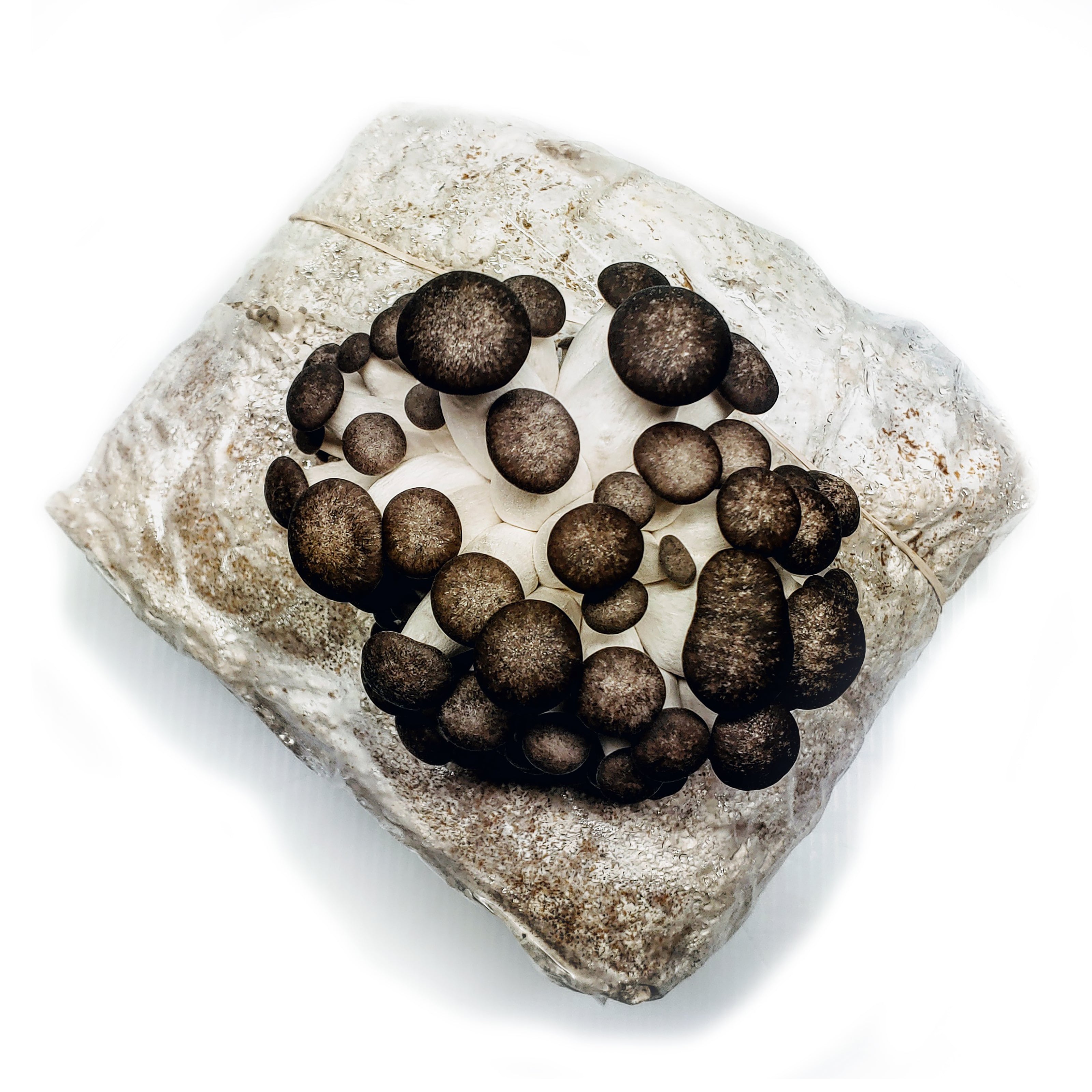
Black Pearl Oyster Strains
PO-BO
Black Pearl Oyster, like most Pleurotus varieties, can thrive on a wide variety of substrate recipes. It is highest-yielding on master's mix, hydrated to 60-63% total moisture content.
Incubation ranges from 14-21 days, depending on factors such as ambient incubation temp, spawn rate and substrate recipe. Unlike many other Pleurotus strains, Black Pearl Oyster does not pin immediately after colonization is complete, providing a grace period in which you can determine when to move your blocks into fruiting.
PO-BO prefers cool fruiting temps between 55-65° F, though can be fruited in warmer temps with mixed results. A standard x-cut or slit through the bag and into the substrate (no more than ½”) is the recommended initiation technique. If fruited in cold temps, Black Oysters manifest the morphology that most cultivators have come to expect- king oyster-like stems and dark, speckled caps. If fruited in warmer conditions, black pearl manifests in morphology a bit more similar to blue oyster, though with fleshier stems.
These are also a very popular sale at farmers markets and the like. They have a mild nutty and umami flavor similar to other oyster strains.
Top fruiting has become increasingly popular with PO-BO which increases the yield and shows off the P. eryngii genetics inherent in its hybridization.
Check out our MycoWizards PhenoFlick on Black Oyster HERE!
All Strains Explained
Blue Oyster Strains
PO-CNS
This is our bestselling house strain of Blue Oyster. Like most Pleurotus varieties, it can thrive on a wide variety of substrate recipes. It is highest-yielding on our master's mix combo-pellets, hydrated to 61% total moisture content.
Incubation ranges from 7-14 days, depending on factors such as ambient incubation temp, spawn rate, and substrate recipe. To avoid stroma and other biological problems during incubation, ensure that the core temperature of your PO-CNS blocks do not exceed 80F at the core. This can be achieved by incubating at 65F.
Bring blocks into the cold storage or the fruit room immediately after incubation is complete, as this strain pins fast and furious. A standard x-cut or slit through the bag and into the substrate (no more than ½”) is the recommended initiation technique. This strain of blue oyster prefers fruiting temperatures between 60-65° F. It maintains a vivid blue color and produces denser fruits of higher quality and a longer shelf life if fruited in cold temperatures. Yield typically ranges from 2½ -3½ lb per 10lb master’s mix block. It is known for very large cap size and tender stems all the way to their base, rendering the whole cluster marketable to a gourmet clientele.
This is a very versatile mushroom that will go good in many dishes such as stir fry, pasta, curry or even simply pan fried by themselves. This mushroom makes a great meat replacement. This strain has also been known to sell well at farmers markets.
PO-CHO
The 'chocolate' oyster is a blue oyster strain from China, sent to us by way of friends in Australia. At this point, it's been cultivated extensively by our farm customer base. It is less aggressive to pin compared with PO-CNS after colonization is complete. It yields very well, produces fruits of high quality (those with caps a bit smaller than a strain like POCNS), but thrives in warmer temps than the average blue strain and demonstrates some resistance to blotch and other bacteria. Its exceptional texture and culinary quality, as well as its slight brown hue to the caps, has made it very popular with chef and home grower alike!
PO-3044
PO-3044 is one of the more popular Blue Oyster varieties we offer. It is known for slightly smaller cap sizes than our house strain, PO-CNS, but still produces clusters of similar size.
PO-3044, like most Pleurotus strains, can thrive on a wide variety of substrate recipes. It is highest-yielding on master's mix, hydrated to 60-63% total moisture content. Calcium carbonate supplementation can help to slightly increase yield and fruit quality. It is best to have a tight contact between the block and the cultivation bag, which helps to prevent premature pinning inside the bag.
Incubation timelines ranges from 7-14 days, depending on factors such as ambient incubation temp, spawn rate, and substrate recipe. To avoid stroma and other biological problems in incubation, ensure that the core temperatures of your blocks do not exceed the low 70s F.
Bring blocks into cold storage or the fruit room immediately after incubation is complete, as this strain pins fast. A standard x-cut or slit through the bag and into the substrate (no more than ½”) is the recommended initiation technique. This strain of blue oyster prefers fruiting temperatures between 55-65° F, but can be fruited in slightly warmer conditions if necessary. It maintains a vivid blue color and produces denser fruit of higher quality and shelf life if fruited in cold temperatures. Yield typically ranges from 2½ -3½ lb per 10 lb master’s mix block. Great shelf life if fruited in cold conditions, shorter shelf life when fruited in warm conditions. A very predictable, flexible, and reliable strain overall.
Just like the PO-CNS strain, this variety is a great addition to any fruiting room.
PO-3015
If you know, you know...some love it, some hate it. This Blue oyster strain is something that simply exists for the folks who have come to rely on it!
PO-KB
The PO-KB strain is a result of breeding carried out by Mossy Creek Mushrooms, this is a somewhat less predictable blue oyster strain, but an ideal choice for those with variable fruiting conditions and/or warm average fruiting temperatures.
Like most Pleurotus varieties, the PO-KB strain can thrive on a wide variety of substrate recipes. It is highest-yielding on master's mix, hydrated to 60-63% total moisture content.
Incubation ranges from 7-16 days, depending on factors such as ambient incubation temp, spawn rate, and substrate recipe. To avoid stroma and other biological problems in incubation, ensure that the core temperatures of your blocks do not exceed the lower 70s F
Bring blocks into the fruit room immediately after incubation is complete, as this strain pins readily. A standard x-cut or slit through the bag and into the substrate (no more than ½”) is the recommended initiation technique. This strain of blue oyster prefers fruiting temperatures between 60-70° F, but can be fruited in colder and semi warm conditions if necessary. It maintains a vivid blue color and produces denser fruit of higher quality and shelf life if fruited in cold temperatures. Yield typically ranges from 2 -3 lb per 10lb master’s mix block. It is known for average cap size but still produces very large clusters. Great shelf life if fruited in cold conditions, shorter shelf life when fruited in warm conditions.
Just like the PO-CNS strain, this variety is a great addition to all your favorite dishes; and any type of Blue Oyster tends to be in high demand if you're looking to sling the fungi!
PO-LOG
While this strain is not as high-yielding or high in quality, when compared to other blue oyster strains, it is still known for its overall ease in cultivation, resistance to bacterial blotch and other contaminants, and its exceptional shelf life. This phenotype certainly maintains the longest post-harvest shelf life of any blue oyster strain we carry, thus making it a great strain option for wholesaling to distributors.
Like most Pleurotus varieties, PO-LOG can thrive on a wide variety of substrate recipes. It is highest-yielding on master's mix, hydrated to 60-63% total moisture content.
Incubation ranges from 10-18 days, depending on factors such as ambient incubation temp, spawn rate, and substrate recipe.
A standard x-cut or slit through the bag and into the substrate (no more than ½”) is the recommended initiation technique. This strain of blue oyster prefers fruiting temperatures between 55-65° F, but can be fruited in warmer conditions if necessary. Yield typically ranges from 2-2½ lb per 10lb master’s mix block. A very predictable, flexible and reliable strain overall.
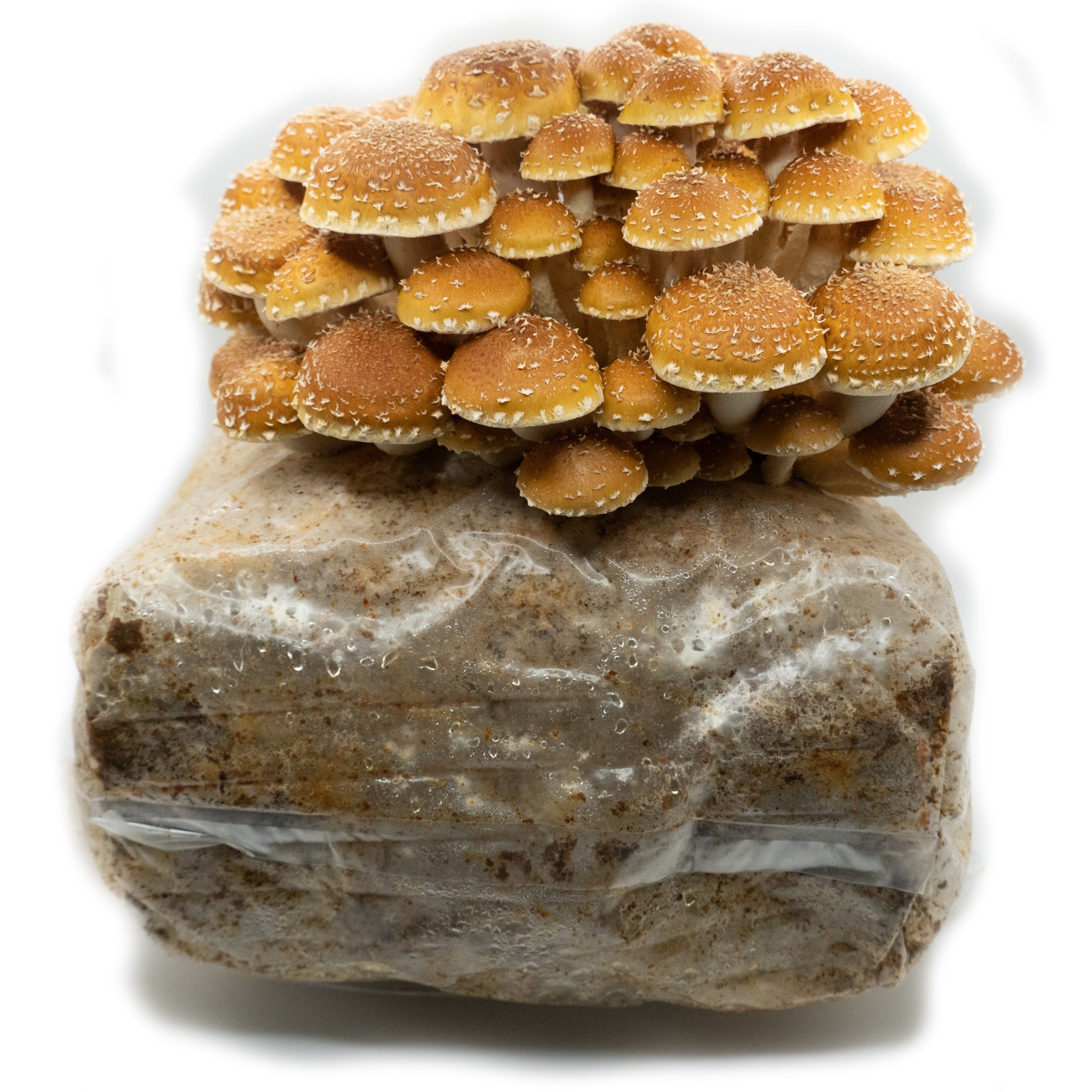
Chestnut Strains
PA-CNS
The infamous and mighty Chestnut strain PA-CNS thrives on master’s mix, especially if pelletized (the pelletization process breaks down the oak, rendering it more bioavailable for a weak metabolizer like chestnut) hydrated to 61-63%.
Initial colonization takes 3 weeks on average, but we recommend that you let the blocks sit for 1 additional week to fully mature- the block will swell with caramel-colored secondary metabolites. This allows the mycelium time to more effectively digest its growing medium, which leads to a faster and larger pinset once introduced into fruiting. Similar to most varieties, avoid letting the internal temperature of your blocks exceed the upper 70s to avoid deleterious biological impacts. Be mindful that chestnut mycelium is more prone to mold contamination than most other common varieties.
Chestnut prefers fruiting temperatures between 55-65° F (12-18° C), if the temperature exceeds 65° it will likely not pin at all. High relative humidity (90-95% ) is recommended for fast and healthy pinning. This is a more intermediate species to work with, if the conditions are not just right you will have a hard time harvesting anything off of the block.
A deep cut into the block is highly recommended for a dense pinset and high yield. Pinset emergence takes longer with chestnut than most other common varieties- 14 to 21 days in most cases. Once pins emerge, it is a fairly rapidly growing mushroom. Harvest after veils break but before caps flatten. Though chestnut does not have a fantastic shelf life, it is a strikingly beautiful mushroom and often sells fast. Average yield ranges between 2 and 3lbs.
Chestnuts have a nutty and meaty flavor, great for many dishes like pasta, soup or as a pizza topping. They are also good for drying as this will improve shelf life.
Check out out MycoWizards PHenoFlick on PA-CNS HERE!
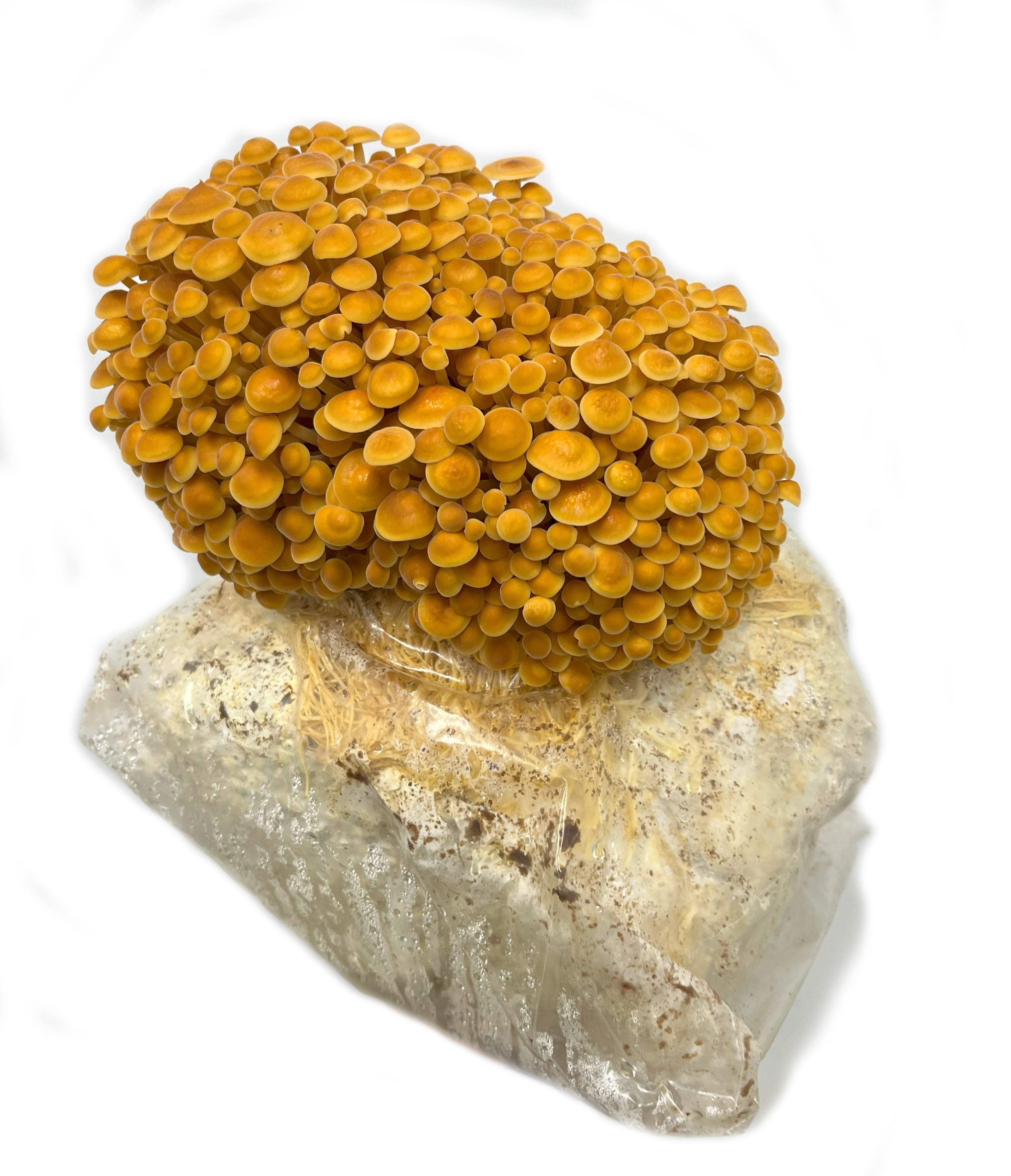
Enoki Strains
Golden Enoki FV-4600
Enoki is very tenacious and can grow on a variety of substrates, but we recommend master's mix for fastest growth and highest yields. Recommended moisture content is 60-63%, Calcium carbonate supplementation can help to slightly increase yield and fruit quality. It is best to have a tight contact between the block and the cultivation bag, which helps to prevent premature pinning inside the bag.
Enoki is fully colonized between 14-21 days in most circumstances. As with most varieties, enoki mycelium thrives with its interior temperature rests in the upper-70s Fahrenheit.
Enoki prefers cold fruiting temps, ideally 50-63° F. Some growers cold shock blocks for several days prior to inducing fruiting. Most growers top fruit enoki sometimes through scratching the top surface of the block. To encourage the most spindly spaghetti like form, let the pins form in vitro or fruit them in a high CO2 environment. If fruited in a regular fruiting environment with high oxygen levels, they will still be thin stemmed but with approximately dime-sized caps.
Enoki is sensitive to bacterial infection in the fruits, so avoid condensation settling on the fruits for a long period of time. Much like other common gourmet varieties, Enoki caps will flatten once they reach full maturity. So keep an eye on them to harvest before flattening for better storage life. FV 4600 can be quite high yielding and can be fruited multiple times with one block.
Enoki mushrooms are quite popular, they have a crunchy texture and umami flavor. They are good in a variety of dishes including soups, stir fry or even just by themselves.
White Enoki FV-1037
FV-1037 is a special order status strain. It is grown in the same conditions as Gold Enoki, however, your incubation and fruiting rooms need to be very on point as this is an overall weaker strain and needs exact conditions. The main appeal of the FV-1037 is the beautiful stark white color, as it was bred specifically for that purpose.
For substrate, we recommend master's mix for fastest growth and highest yields. Recommended moisture content is 60-63%, Calcium carbonate supplementation can help to slightly increase yield and fruit quality. It is best to have a tight contact between the block and the cultivation bag, which helps to prevent premature pinning inside the bag.
Enoki is typically fully colonized between 14-21 days in most circumstances. As with most varieties, enoki mycelium thrives with its interior temperature rests in the upper-70s Fahrenheit. Enoki prefers cold fruiting temps, ideally 50-63° F. Some growers cold shock blocks for several days prior to inducing fruiting. Most growers top fruit enoki sometimes through scratching the top surface of the block. To encourage the most spindly spaghetti like form, let the pins form in vitro or fruit them in a high CO2 environment.
Enoki is sensitive to bacterial infection in the fruits, so avoid condensation settling on the fruits for a long period of time. Much like other common gourmet varieties, Enoki caps will flatten once they reach full maturity. So keep an eye on them to harvest before flattening for better storage life.
If you would like to try this strain be sure to write *Special Order* at the bottom of your Spawn Form.
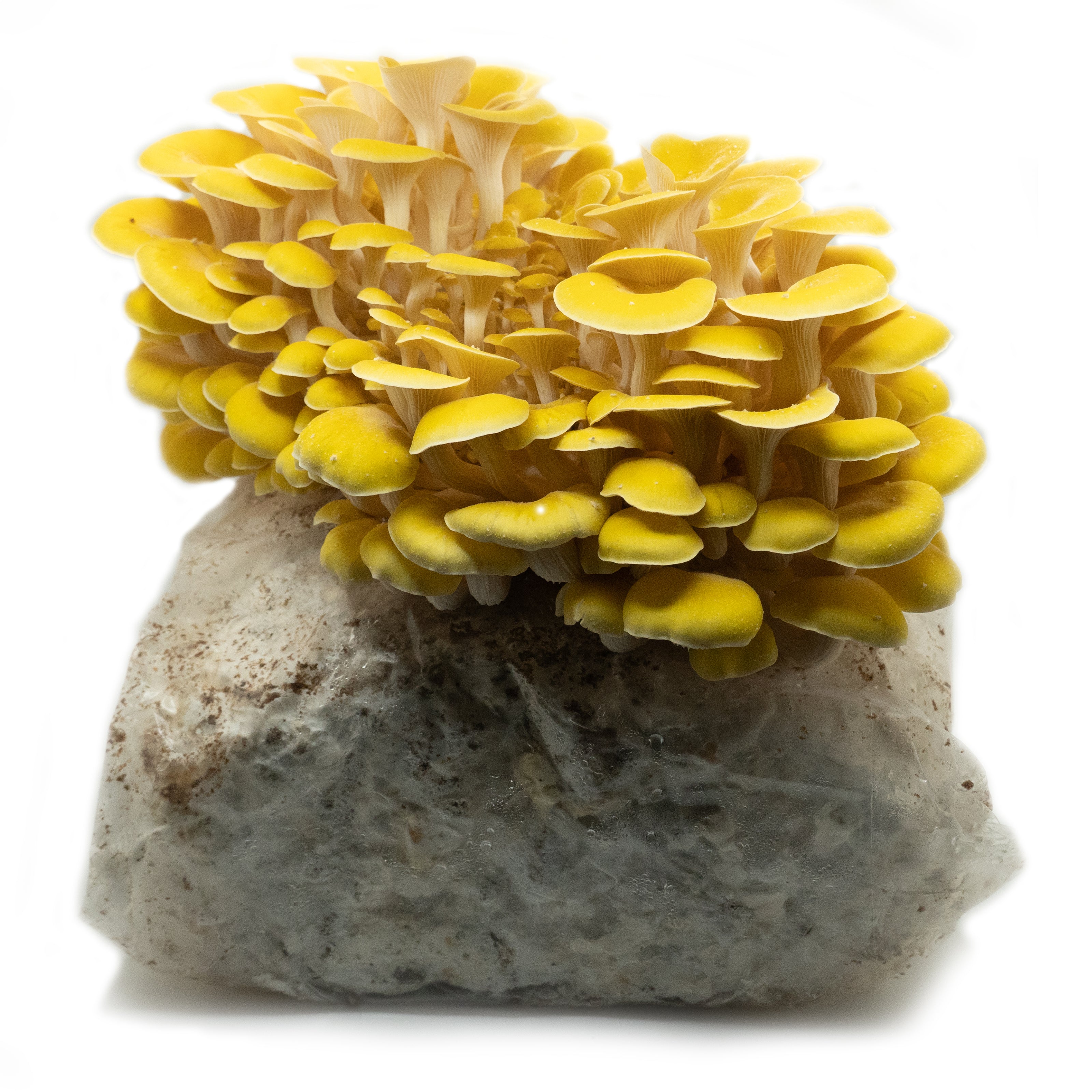
Gold Oyster Strains
PC-MM
Gold Oyster, like most Pleurotus varieties, can thrive on a wide variety of substrate recipes. It is highest-yielding on master's mix, hydrated to 60-63% total moisture content.
Incubation ranges from 7-14 days, depending on factors such as ambient incubation temp, spawn rate, and substrate recipe. To avoid stroma and other biological problems in incubation, ensure that the core temperatures of your blocks do not exceed the low 70s.
Bring blocks into the fruit room immediately after incubation is complete, as this strain pins readily. A standard x-cut or slit through the bag and into the substrate (no more than ½”) is the recommended initiation technique. This strain of Gold Oyster prefers immense flood lighting with fruiting temperatures between 65-70° F, but can be fruited in cooler conditions if necessary. It maintains a vivid color and higher yields when fruited in those warmer conditions. This strain can easily be fruited several times, but still has a high first flush yield. Its fruits develop rapidly; yield typically ranges from 2½ -3½ lb per 10 lb master’s mix block.
Pleurotus citrinopileatus is known for smaller cap size than other oyster species and for very delicate fruit tissue that is easily damaged. This PC-MM strain demonstrates stronger fruit tissue than average, while still maintaining a nice texture for gourmet cuisine. Mediocre shelf life. Fungus gnats and other insect pests are attracted by remnants of p. citrinopileatus fruits, so be sure to cut clean against the block when harvesting, and move the blocks to compost as soon as you are done flushing. A very predictable, flexible, and reliable strain overall.
Gold Oysters are desirable mainly because of their beautiful bright yellow color and notably nutty flavor.
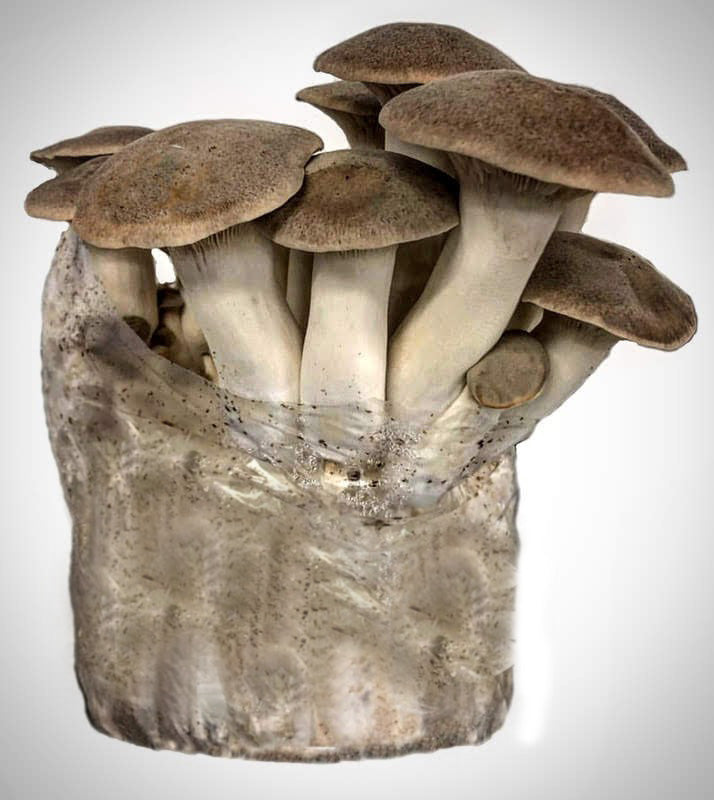
King Oyster Strains
PE-KONG
King oyster, like most Pleurotus varieties, can thrive on a wide variety of substrate recipes. It is highest-yielding on master's mix, hydrated to 60-63% total moisture content. It is best to have a flat top surface of your block and tight contact between the block and the cultivation bag, which encourages growth across the entire surface rather than along the edges of the block.
Incubation ranges from 14-21 days, depending on factors such as ambient incubation temp, spawn rate, and substrate recipe.
Bring blocks into the fruit room immediately after incubation is complete, as king oyster pins readily. There are three typical pin initiation approaches- letting the pins form in vitro before cutting off the seal and/or top portion of the bag, immediately cutting off the seal and/or top portion of the bag and scratching the top surface of the block, or simply cutting off the seal and/or top portion of the bag. Some farms like to form a casing layer (such as with peat moss and hydrated lime) for the fruits to emerge from. All have their merits and depend on the fruiting environment and grower preference. King oyster prefers cold fruiting temperatures between 50-60° F. Rapid pin growth and ideal morphology are encouraged through exposure to blue lighting; full spectrum LED is fine, if not too strong. Its fruits develop rapidly; yield typically ranges from 2-2.5 lb per 10lb master’s mix block and boast an excellent shelf-life.
King Oysters are a delicious and meaty mushroom, a great option as a meat replacement.
Check out our King Oyster Cultivation Deep Dive on our MycoWizards page!
PE-2603
PE2603 tends toward more uniformly medium-sized fruits with a pale, beige hue to the caps, while PEKONG demonstrates much more variance in fruit size with a stronger granite hue to the caps.
King oyster, like most Pleurotus varieties, can thrive on a wide variety of substrate recipes. It is highest-yielding on master's mix, hydrated to 60-63% total moisture content. It is best to have a flat top surface of your block and tight contact between the block and the cultivation bag, which encourages growth across the entire surface rather than along the edges of the block.
Incubation ranges from 14-21 days, depending on factors such as ambient incubation temp, spawn rate, and substrate recipe.
Bring blocks into the fruit room immediately after incubation is complete, as King Oyster pins readily. There are three typical pin initiation approaches- letting the pins form in vitro before cutting off the seal and/or top portion of the bag, immediately cutting off the seal and/or top portion of the bag and scratching the top surface of the block, or simply cutting off the seal and/or top portion of the bag. Some farms like to form a casing layer (such as with peat moss and hydrated lime) for the fruits to emerge from. All have their merits and depend on the fruiting environment and grower preference. King oyster prefers cold fruiting temperatures between 50-60° F. Rapid pin growth and ideal morphology are encouraged through exposure to blue lighting; full spectrum LED is fine, if not too strong. Its fruits develop rapidly; yield typically ranges from 2-2.5 lb per 10lb master’s mix block and boast an excellent shelf-life.
King Oysters are a delicious and meaty mushroom, a great option as a meat replacement.
Check out our King Oyster Cultivation Deep Dive on our MycoWizards page!
PE-REX
- Demonstrates higher blotch resistance and overall vigor
- Smaller, more attractive caps
- Much softer texture than other strains, great in a gourmet context
- More even fruit body size, easier to grade
- Similar yield to other commercial strains such as KONG and 2603
- Slightly slower to pin and harvest than KONG, by approximately one week
Lions Mane Strains
HE-CNS
HE-CNS is our go to house strain of Lion's Mane. HE-CNS produces the highest yield on master’s mix. We strongly recommend a final block moisture content of 60%; a moisture content even slightly exceeding that tends to lead to problems during incubation and fruiting for lion’s mane. In turn, insufficient moisture content often leads to issues with mold contamination and overall poor colonization of the block. Lion’s mane does equally well with ultrapasteurization and sterilization.
Incubation ranges from 8 to 16 days, depending on factors such as ambient incubation temp, spawn rate, and substrate recipe. Similar to most varieties, avoid letting the internal temperature of your blocks exceed the low 70s internally. Be mindful that Lion’s Mane mycelium is prone to myriad problems if it overheats and that it is more prone to mold contamination than most other common varieties.
Lion’s Mane prefers standard fruiting temperatures between 55-65° F (12-18° C). A high air exchange rate (lots of oxygen-rich air) and consistent relative humidity are ideal for good fruit development. A standard x-cut or slit in the bag is the recommended pinset initiation technique; many farms make their cut on the top surface of the block, where lion’s mane readily fruits on its own accord. Lion’s mane fruits develop at a relatively slow rate but grow to incredibly large size and weight. Average yield is quite high- 2½ to 3½ lb, with potential for even more with subsequent flushes of the same block. This strain is known for dense, club-like fruits with small spines, providing greater resistance to bruising and damage during handling/cold storage thus making it an eminent wholesaling mushroom.
Lion's Mane is not only a great versatile ingredient, it is also said to have many medicinal properties.
Check out our MycoWizards PHenoFlick on HE-CNS Here!
HE-POW
The HE-POW strain is different than typical Lion's Mane as it has demonstrated higher heat tolerance than other strains and is often the preferred strain by farms in hot climates and/or hot seasons.
HE-POW, like most Lion's Mane strains, produces the highest yield on master’s mix, but is easier to grow without issue on a lower-supplementation recipe, such as 65-70% hardwood and 30-35% wheat middlings/soy hulls. Regardless, we strongly recommend a final block moisture content between 59-62%; a moisture content even slightly exceeding that tends to lead to problems during incubation and fruiting for lion’s mane. In turn, insufficient moisture content often leads to issues with mold contamination and overall poor colonization of the block. HE-POW does equally well with ultrapasteurization and sterilization.
Incubation ranges from 8 to 16 days, depending on factors such as ambient incubation temp, spawn rate, and substrate recipe. Similar to most varieties, avoid letting the internal temperature of your blocks exceed the low 70s to avoid deleterious biological impacts; be mindful that lion’s mane mycelium is prone to myriad problems if it overheats, such as mold and bacterial contamination.
A standard x-cut or slit in the bag is the recommended pinset initiation technique; many farms make their cut on the top surface of the block, where it readily fruits on its own accord. Lion’s mane fruits develop at a relatively slow rate (14-21 days) but grow to an incredibly large size and weight. Average yield is quite high- 2½ to 3lb or more per 10lb master’s mix block, with potential for even more if fruited multiple times per block.
This strain is known for flashier fruits with more exposed spines, with excellent visual appeal while still maintaining wholesale production standards.
HE-LP
The fruit quality of this strain is not quite as gourmet as other Hericium strains offered by Cap N’ Stem, but its flexible cultivation parameters makes it a worthwhile consideration for some farms.
Lion’s Mane produces the highest yield on master’s mix, but is easier to grow without issue on a lower-supplementation recipe, such as 65-70% hardwood and 30-35% wheat middlings/soy hulls. Regardless, we strongly recommend a final block moisture content between 59-62%; a moisture content exceeding that tends to lead to problems during incubation and fruiting for lion’s mane, especially bacterial infections and subsequent pooling of secondary metabolites. In turn, insufficient moisture content often leads to issues with mold contamination and overall poor myceliation of the block. Lion’s mane does equally well with ultrapasteurization and sterilization.
Incubation ranges from 8 to 16 days, depending on factors such as ambient incubation temp, spawn rate, and substrate recipe. This strain is slightly more tolerant than other Hericium strains of varying moisture content in the block as well as varying incubation temperatures, making it a safe choice for farms with an inconsistent incubation environment.
Lion’s Mane thrives with lots of fresh air exchange and abundant oxygen levels, also ensure that you maintain high relative humidity without allowing condensation settling too long on the fruits, as lion’s mane is prone to both desiccation and bacterial rot. A standard x-cut or slit in the bag is the recommended pinset initiation technique. Many farms make their cut on the top surface of the block, where lion’s mane readily fruits on its own accord. Lion’s Mane fruits develop at a relatively slow rate (14-21 days) but grow to incredibly large sizes and weight. Average yield is less than other Lion’s Mane strains- 2 to 2½ lb- with potential for more if fruited multiple times per block.
HE-A
HE-A is a special order status strain. It is a wild clone from Quebec. We have not done much production with this strain so a lot of variables are still unknown. The main reason HE-A is special is it has vigorous and dense mycelium, much stronger and flexible than most other Lions Mane strains; This makes it a good contender if you have unstable fruiting conditions.
As this is a wild clone, the fruits of the HE-A look wild and spiny compared to regularly cultivated Lions Mane; which typically appear as a more dense round shape.
We do not have any average yield data as we have not brought this strain into our regular rotation. If you would like to try this strain be sure to write *Special Order* at the bottom of your Spawn Form.
HE-9514
HC-FF
HC-FF, also known as Combtooth or Hericium Corraloides is a commercial phenotype that hails from Funga Farm. The main difference between the strains is morphology; While the typical Lions Mane forms in multiple ball like fruits, the Combtooth has fruits more akin to a coral mushroom, very spread out and textured.
HC-FF produces the highest yield on master’s mix, but is easier to grow without issue on a lower-supplementation recipe, such as 65-70% hardwood and 30-35% wheat middlings/soy hulls. Regardless, we strongly recommend a final block moisture content between 59-62%; a moisture content exceeding that tends to lead to problems during incubation and fruiting for Combtooth, especially bacterial infections and subsequent pooling of secondary metabolites. In turn, insufficient moisture content often leads to issues with mold contamination and overall poor myceliation of the block. Combtooth does equally well with ultrapasteurization and sterilization.
Incubation ranges from 8 to 16 days, depending on factors such as ambient incubation temp, spawn rate, and substrate recipe. When compared to Lions Mane, HC-FF has a much denser mycelium during its colonization of a substrate block as well as spawn. It is less likely to autofruit in the high CO2 environment of a sealed XLS-A bag.
HC-FF thrives with lots of fresh air exchange and abundant oxygen levels, also ensure that you maintain high relative humidity without allowing condensation settling too long on the fruits, as Combtooth is prone to both desiccation and bacterial contamination. A standard x-cut or slit in the bag is the recommended pinset initiation technique; many farms make their cut on the top surface of the block, where Combtooth readily fruits on its own accord.
Typical yield ranges from 2 to 3 lbs. Depending on usual fruiting room factors such as lighting, oxygen levels and moisture content.
Check out our Mycowizards PhenoFlick on HC-FF HERE!
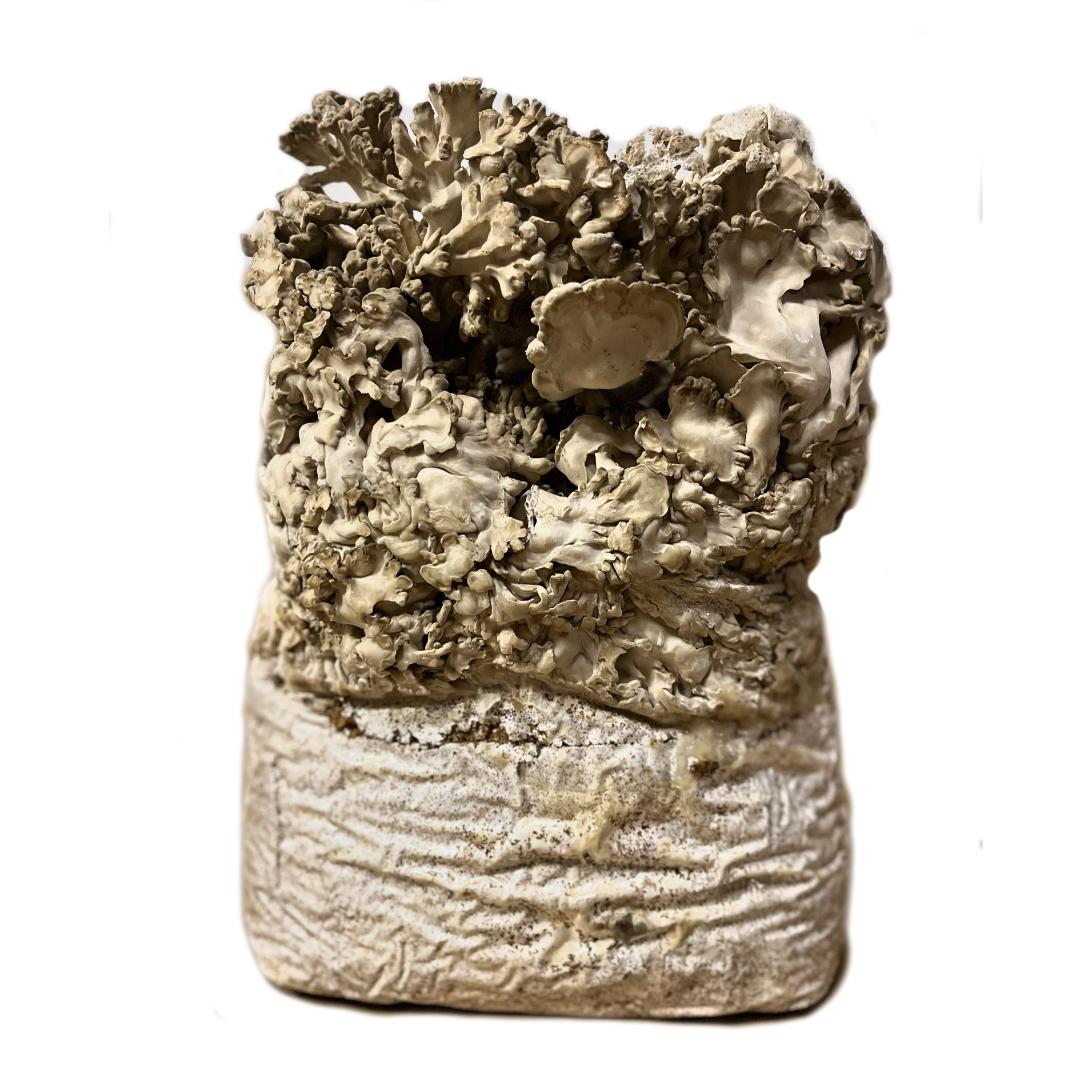
Maitake Strains
GF-494
GF-494 is a special order status strain. It has a slightly slower development rate when compared to other Maitake strains, however, It also has a slightly higher yield and tends to be more durable of a strain which makes it a great option for wholesale farmers.
As with the GF-9827, this is a particular strain when it comes to fruiting conditions; 65° F is recommended for incubation and fruiting. Be sure not to disturb the block as this will likely disrupt the growth of your mushrooms. The GF-494 is less flexible of a strain so all of your conditions should be on point.
If you would like to try this strain be sure to write *Special Order* at the bottom of your Spawn Form.
GF-9827
Maitake prefers a lower supplementation rate than standard masters mix. Something along the lines of 60-70% sawdust/hardwood pellets & 30-40% supplement. A moisture content between 60-63% is recommended to accommodate its longer timeframe in incubation. It is best to have a flat top surface of your block.
Initial colonization of the block will take about 3-4 weeks in most cases, but let the blocks remain in incubation as primordia develop in vitro. Let those primordia get as large as possible in incubation. Initial ‘blob-like’ primordia begin to develop ‘fingers’; this is a clear visual indication that the crop’s time in incubation is complete. Overall, incubation averages 3-4 weeks and primordia development averages 3-5 weeks. Extensive lighting over the top surface of the blocks is extremely helpful to encourage primordia to form along the entire top surface, rather than just along the sides of the top surface, which tends to occur in low-light conditions. Cool spectrum lighting is superior to warm spectrum for healthy primordial development. Maitake seems to have a very wide range in which it will grow, both in incubation and fruiting. As with most varieties, the speed is much greater in warm conditions, and the mushroom quality is greater in cool conditions. Temperature stability is extremely important for successful maitake cultivation. On average, growers tend to cultivate this strain at 65° F for incubation and fruiting.
Cut off the seal to leave a tall plastic collar around the developing fruits, and cut slits on the sides of the bottom of the collar to allow CO2 to flush out. Like any variety, Maitake requires fresh air exchange but is also prone to drying out, so it is best to position the blocks at a slight angle on your fruiting racks/shelves and have a collar that is as high as possible. In hot fruiting conditions, this is especially the case, whereas in cold fruiting conditions you will want to ensure that water doesn't pool inside the collar. For maximum storage life, harvest the fruits right when pores manifest on the undersides of the fronds. For maximum volume, wait to harvest until fruits have begun to produce spores.
As this species is more advanced than most, it is important to have extra consideration in fruiting conditions. Many growers have produced mediocre maitake (very short fronds, about halfway between 'blobtake' and healthy looking maitake) because they didn't have enough patience. Patience is key, especially in regard to letting primordia develop in vitro. If you allow the primordia as much time to develop as possible in vitro, you will see a higher yield, healthier mushrooms, better aroma.
Maitake will stop growing if disturbed too much. This is one of the main considerations for letting the blocks acclimate to the fruiting room before cutting off the seal. The principle of avoiding disturbance applies to other aspects of cultivation- avoid knocking the blocks, and avoid fruiting them in a fruit room with heavy spore load from other varieties (both may lead to growth stopping).
Maitake is said to have a rich earthy flavor with a hint of spice.
Phoenix Oyster Strains
PP-LOG
PP-LOG has been our go to Phoenix oyster strain for a decade. Also referred to as Italian Oyster, Pleurotus Pulmonarius loves the heat and fruits best between the temp range of 60 and 70F.
When it comes down to producing substrate for this variety it is typical to all the other standards of oysters, Masters Mix with 60-63% moisture content. On a 10lb block of substrate keep your incubation temps down around 66F to prevent any bacterial contamination that can proliferate into blotch once introduced into fruiting.
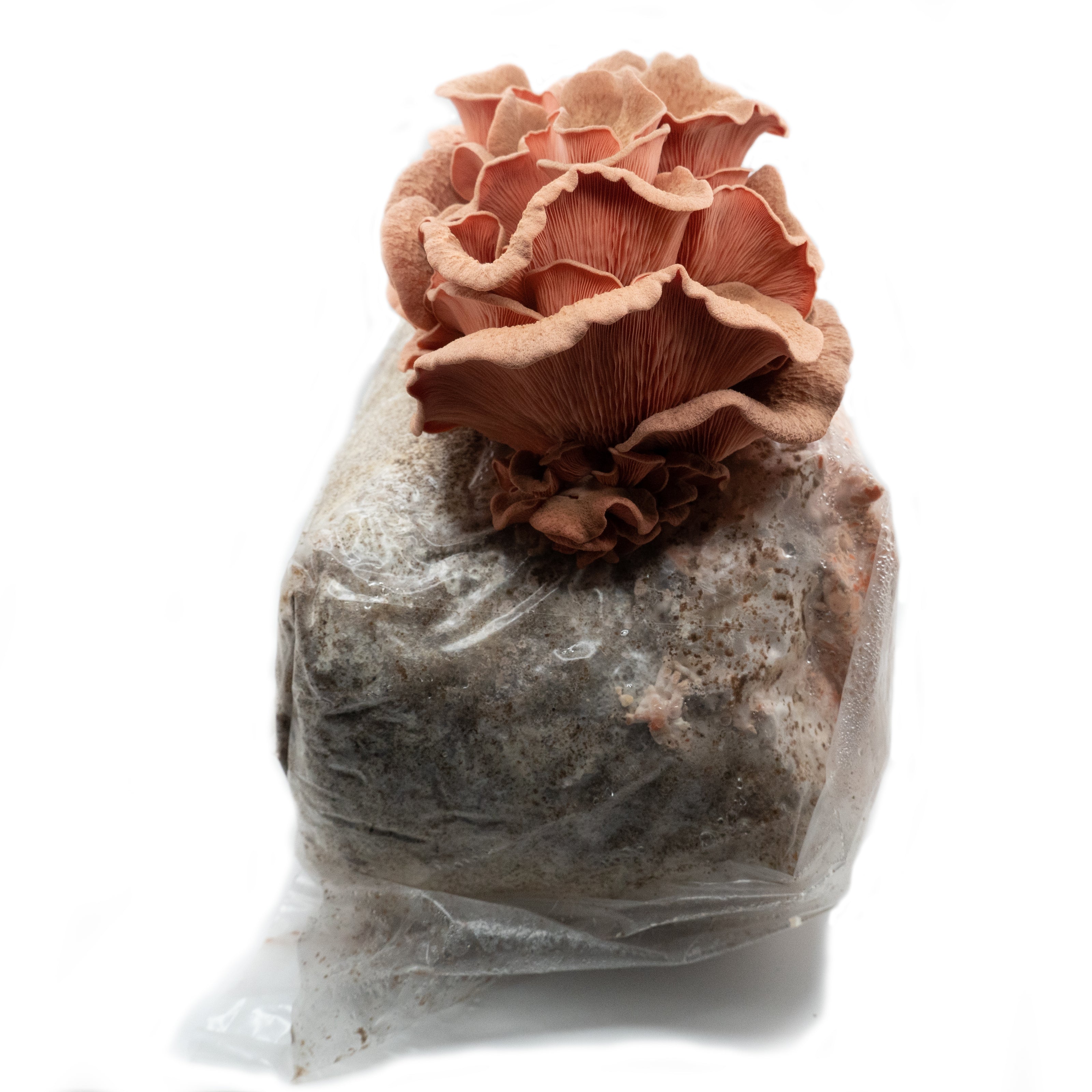
PP-2204
PP-2204 comes from Mycelia BVBA and has been a runner up to our PP-LOG strain for a few years. Also referred to as Italian Oyster, Pleurotus Pulmonarius loves the heat and fruits best between the temp range of 60 and 70F.
When it comes down to producing substrate for this variety it is typical to all the other standards of oysters, Masters Mix with 60-63% moisture content. On a 10lb block of substrate keep your incubation temps down around 66F to prevent any bacterial contamination that can proliferate into blotch once introduced into fruiting.
Pink Oyster Strains
PD-1
Pink Oysters can thrive on a wide variety of substrate recipes. It is highest-yielding on master's mix, hydrated to 60-63% total moisture content. It is best to have a tight contact between the block and the cultivation bag, which helps to prevent premature pinning inside the bag.
Incubation ranges from 10-16 days, depending on factors such as ambient incubation temp, spawn rate, and substrate recipe.
Bring blocks into the fruit room immediately after incubation is complete, as this strain pins all over the block fast. A standard x-cut or slit through the bag and into the substrate (no more than ½”) is the recommended initiation technique. Pink oysters are a tropical strain that prefers fruiting temperatures between 70-80° F with humidity levels between 85-95%. It maintains a vivid pink color if grown with slight light exposure and in their preferred temp range, and can produce thick meaty fruits or thin delicate fruits depending on growing conditions. This strain can easily be fruited several times, but still has a high first flush yield. Its fruits develop rapidly; yield typically ranges from 2½ -3 lb per 10 lb master’s mix block. The nice part about PD-1 is it can be fruited through the winter months if the temps in your fruiting facility stay in the low to middle 60s.
Pink Oysters are known to have a very short life. They also have a meaty texture and a notably "seafood" flavor.
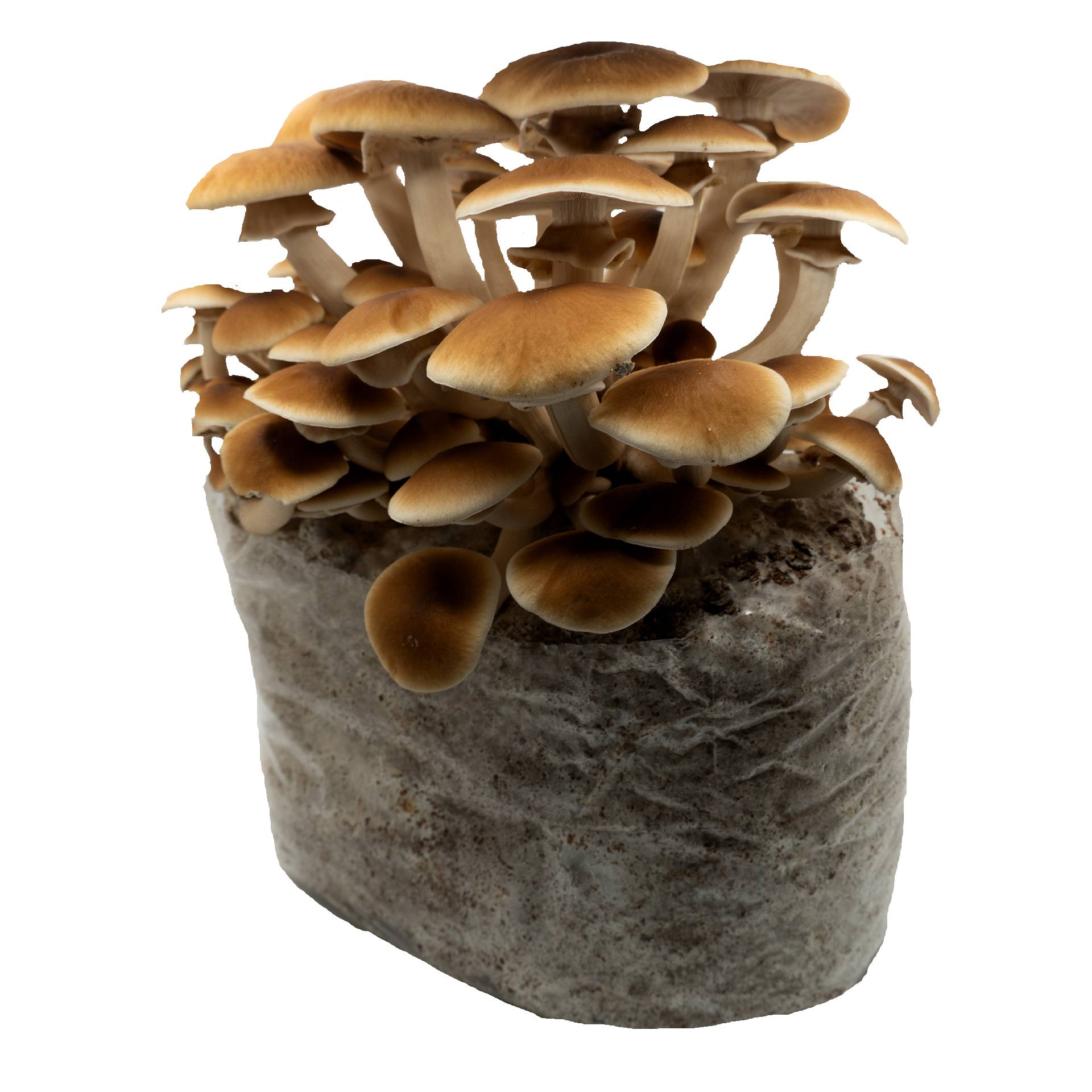
Pioppino Strains
AA-CNS
Pioppino is a relatively delicate mycelium. It obtains its highest yields on masters mix, ideally with a hardwood as its substrate base. For the smoothest colonization and easiest success, some growers cultivate pioppino on recipes similar to shiitakes substrate. Much like other delicate varieties, if pioppino is grown on substrate with insufficient moisture content, its mycelial growth rate is drastically inhibited and its hyphae are less robust and defined. If grown with excessive moisture content bacterial contamination easily occurs. Standard 60-63% moisture content is recommended.
Pioppino takes 18-22 days to fully colonize and be ready to fruit on average. indirect light exposure in incubation encourages more vigorous colonization of the block. When pioppino is ready to fruit cloud like plumes of mycelium form on the top of the block giving way to microdots of a yellow metabolite that forms into primordia. These pins can form on the exterior of the block so its best to maintain tight contact between plastic and block to encourage top fruits. If you catch the block before pillowy mycelium forms but the block is full colonized you can remove the air from the plenum with a small cut at the top of the bag and refrigerate at 34F for several weeks. After refrigeration, a side cut similar to oysters or lions mane will provide a successful and robust flush.
Pioppino prefers warm fruiting temperatures between 65-75 degrees but will fruit in cooler temps as well, just more slowly. It is highest yeilding when fruited from the top of the block. Once pins are formed they grow at a fast rate and will be ready to harvest within 7-10 days on average.
For the best balance of storage life and yield, harvest just when the veils are beginning to show signs of cracking and separating from the stem. This strain of Pioppino is known for mostly even, medium sized fruits. Its yield, while not exceptional, still falls within the range of a commercially viable first flush and outperforms other Pioppino strains that Cap N’ Stem has worked with.
The Pioppinos have a nutty and slightly sweet flavor. It is a popular mushroom in the culinary world.
Check out our MycoWizards PhenoFlick on fascinating strain HERE!
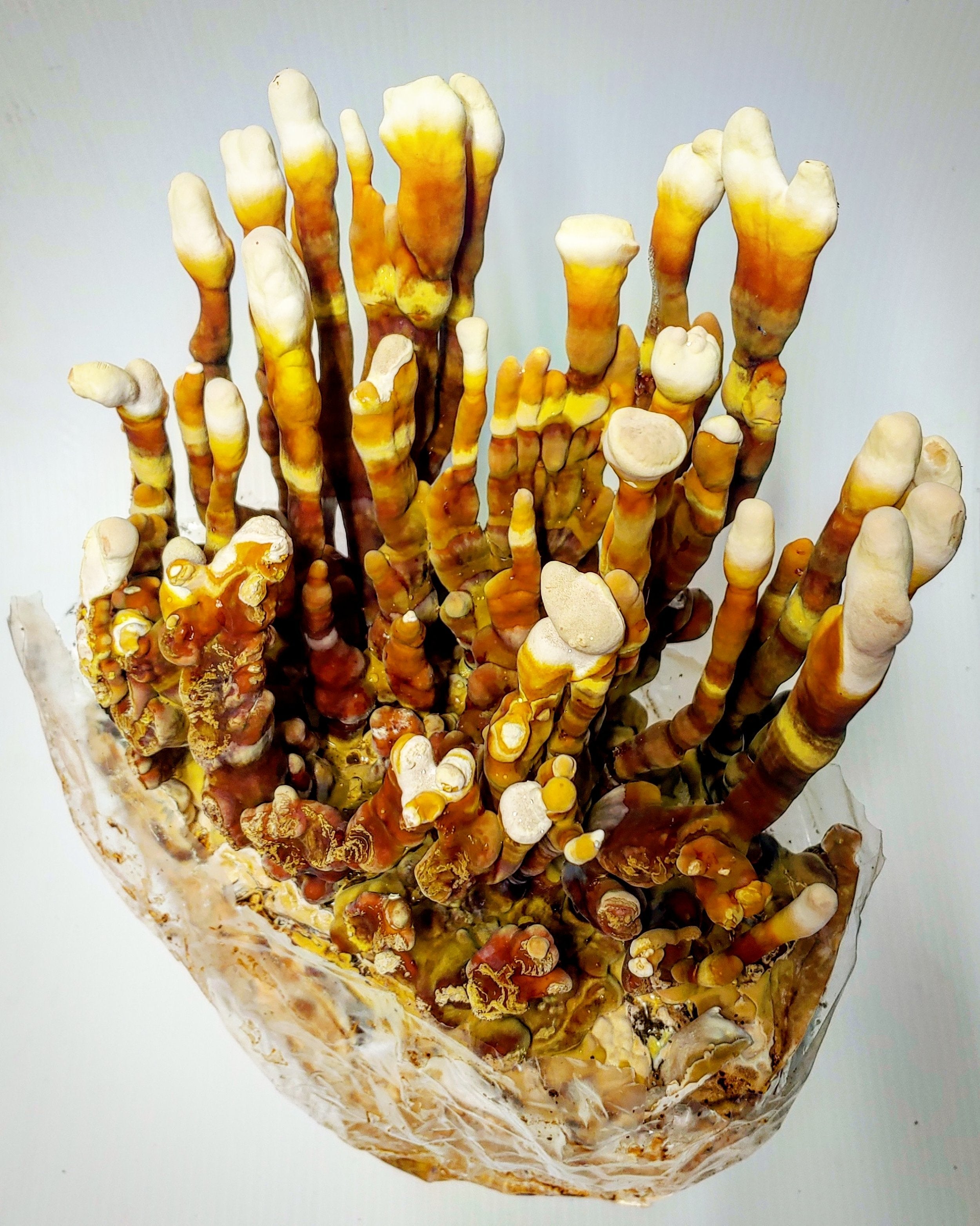
Reishi Strains
GLZ-9724
Reishi species are incredibly tenacious and will thrive on a wide variety of substrate recipes. Masters mix works quite well and allows for high yields. Standard moisture content of 60-63%. If you plan on fruiting antlers in vitro, be sure to have as large a plenum in the bag as possible to provide maximum amount of space for antlers to grow.
Reishi typically requires 10-16 days for full colonization. Reishi is a strong competitor and will outcompete most contaminants if they're not too prevalent. If you plan to fruit antlers in vitro, set them and forget them, ideally with good light exposure to stimulate faster fruit growth. If you plan to fruit conks, move them into your fruit room as soon as you see either a swelling of secondary metabolites and/or myelination along the exterior of the substrate.
While Reishi myceliates very fast, its fruits grow at a very slow, steady rate. Depending on context, reishi fruits reach maturity anywhere between 3-6 months; some cultivators extend their growth beyond that. Some strains are bred specifically for antler morphology, others for conk, and others are flexible. You can grow antlers in vitro or in a fruiting space with artificially elevated CO2 levels. If you want to grow conks, cut the bag in a similar fashion as you would oysters; primordia will quickly manifest. For conks, maintain a standard fruiting room environment- around 90% relative humidity and the usual 450-800 ppm CO2. This will encourage the organism to continue growing fruit body size rather than sporulating. Ideally, harvest before the mushrooms sporulate, as Reishi spores both contain medicinal potency and are very virulent and irritating to the respiratory system (and your equipment!).
Reishi is a great mushroom for tinctures as they are said to have many medicinal properties.
Check out our MycoWizards Deep Dive on the History Of Reishi HERE!
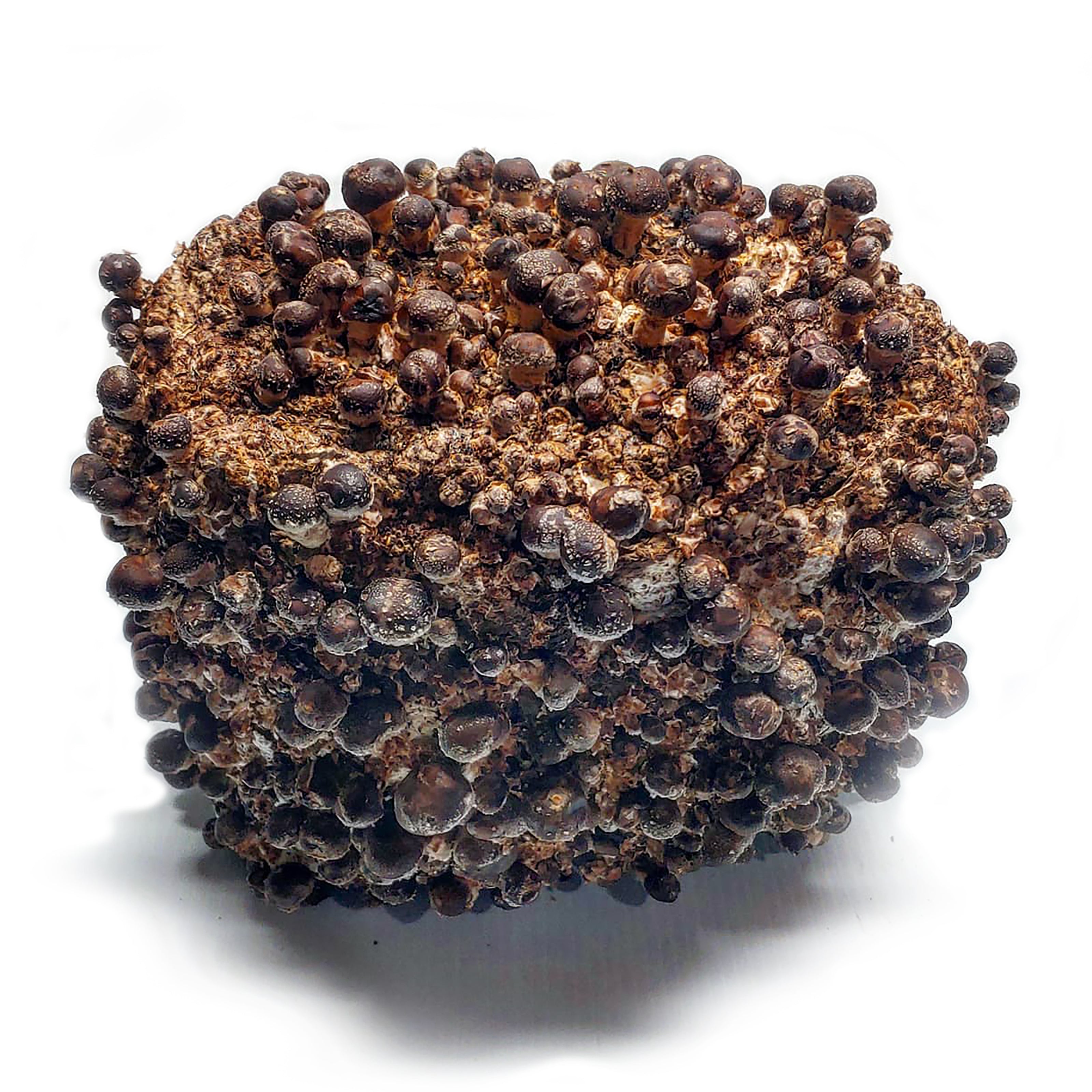
GM-CNS
GM-CNS is an incredibly tenacious species and will thrive on a wide variety of substrate recipes. Ganoderma Multipileum grows faster and antlers quicker than Ganoderma Lingzhi with less dense fruits in a pillowy zig zag fashion depending on the light spectrum. Masters mix works quite well and allows for high yields. Standard moisture content of 60-63%. If you plan on fruiting antlers in vitro, be sure to have as large a plenum in the bag as possible to provide maximum amount of space for antlers to grow.
Reishi typically requires 10-16 days for full colonization. Reishi is a strong competitor and will outcompete most contaminants if they're not too prevalent. If you plan to fruit antlers in vitro, set them and forget them, ideally with good light exposure to stimulate faster fruit growth. If you plan to fruit conks, move them into your fruit room as soon as you see either a swelling of secondary metabolites and/or myelination along the exterior of the substrate.
While Reishi myceliates very fast, its fruits grow at a very slow, steady rate. Depending on context, reishi fruits reach maturity anywhere between 3-6 months; some cultivators extend their growth beyond that. Some strains are bred specifically for antler morphology, others for conk, and others are flexible. You can grow antlers in vitro or in a fruiting space with artificially elevated CO2 levels. If you want to grow conks, cut the bag in a similar fashion as you would oysters; primordia will quickly manifest. For conks, maintain a standard fruiting room environment- around 90% relative humidity and the usual 450-800 ppm CO2. This will encourage the organism to continue growing fruit body size rather than sporulating. Ideally, harvest before the mushrooms sporulate, as reishi spores both contain medicinal potency and are very virulent and irritating to the respiratory system (and your equipment!).
Reishi is a great mushroom for tinctures as they are said to have many medicinal properties.
Check out our MycoWizards Deep Dive on the History Of Reishi HERE!
Shiitake Strains
LE-KOM
LE-KOM is much like any other Shiitake strain except it has a faster incubation rate, this is a good strain for wholesale farmers. Shiitake in general requires a less-rich growing medium than other varieties; the standard recipe is 20-30% wheat bran/middlings, 70-80% oak/harwood, hydrated to 63-65%. It prefers sterilized growing media rather than pasteurized growing media, though both can be successful.
Initial colonization takes 2-3 weeks; total time to fully browned maturity ranges from 7-9 weeks- this strain is exceptionally fast, relative to other shiitake strains and extremely forgiving. To ensure healthy popcorning, rather than blistering, ensure that you maintain stable ambient temperatures during incubation. To ensure proper browning, allow for even all spectrum light exposure to the blocks, even if indirect. To avoid overheating and its cataclysmic associated issues, as well as premature pinning in vitro, ensure that the core temperatures of your blocks do not ever exceed the low 70s, even for short time intervals. This strain has proven to be reasonably tolerant of variable substrate moisture content, but it is best practice to stick within the recommended 63-65% MC range and to avoid any standing water inside the cultivation bag.
This strain performs reasonably well through a wide temperature range, though 55-70° F is recommended for highest quality fruits and shelf life. Cold shocking is helpful to initiate a fast and robust pinset but is optional. It mostly produces medium-size caps of good quality with a smaller amount of large-size caps and few petite caps. If cultivated on 10lb blocks, it tends to produce a higher amount of large caps than if cultivated on 5 lb blocks. Its fruits develop rapidly and are easy to cultivate, as with most shiitake strains. For the highest quality, harvest soon after the veils break. For highest yield, allow the caps to swell with water as they flatten (this results in poor quality and shorter shelf life). Its stems tend to be fairly fleshy and marketable. Average yield typically ranges between 2½-3lbs per 10lb block.
Shiitakes in general are great mushrooms for soups, sauces and stir fry. They are one of the most in demand mushrooms in the US right now.
LE-321
LE-321 is a special order status strain from northwest mycological consultants. It is a classic shiitake strain and requires all the same care. The standard substrate recipe for Shiitakes is 20-30% wheat bran/middlings, 70-80% oak/harwood, hydrated to 63-65%. It prefers sterilized growing media rather than pasteurized growing media, though both can be successful. Incubation and fruiting temp should be around 60° F. It is lower yielding than other commercial strains but produces very gourmet fruits.
If you would like to try this strain be sure to write *Special Order* at the bottom of your Spawn Form.
LE-3790
LE-3790 is our most common shiitake in substrate and spawn sales. Shiitake in general requires a less-rich growing medium than other varieties; the standard recipe is 20-30% wheat bran/middlings, 70-80% oak/harwood, hydrated to 63-65%. It prefers sterilized growing media rather than pasteurized growing media, though both can be successful.
Initial colonization takes 2-3 weeks; total time to fully browned maturity ranges from 11-14 weeks. To ensure healthy buckling, rather than popcorning, ensure that you maintain stable ambient temperatures during incubation. To ensure proper browning, allow for some light exposure to the blocks, even if indirect. To avoid overheating and its cataclysmic associated issues, as well as premature pinning in vitro, ensure that the core temperatures of your blocks do not ever exceed the low 70s, even for short time intervals.
This strain prefers fruiting temperatures between 55-66° F, in which it will produce its largest, highest quality caps, but can be fruited in warmer conditions as well, in which its yield will be comparable but its cap size will trend smaller. Cold shocking is helpful to initiate a fast and robust pinset but is optional. If cultivated on 10 lb blocks, it tends to produce a higher amount of large caps than if cultivated on 5 lb blocks. For highest quality and shelf life, harvest soon after the veils break. Its stems tend to be fairly fleshy and marketable. LE 3790 boasts the highest average yield of our shiitake strains, typically between 3-4 lbs.
For more info on 3790 check out ourMycoWizards PhenoFlick HERE!
LE-3782
The OG, The strain to get the small cultivators of the US started back when Aloha Medicinals brought it in from Mycelia BVBA.
While the caps are small the hotter it gets, the cooler weather during fruiting will produce quite nice sized medium cap with a relatively thin outer skin.
So long as incubation temps are kept around 66F for a 10lb block, your sub will run, buckle and brown in under 10 weeks unlike 3790 which can take a bit longer.
While most folks don't cultivate 3782 anymore, it still holds a solid spot in our hearts as being the shiitake strain that made profitability possible!
LE-JC
Shiitake in general requires a less-rich growing medium than other varieties; the standard recipe is 20-30% wheat bran/middlings, 70-80% oak/harwood, hydrated to 63-65%. It prefers sterilized growing media rather than pasteurized growing media, though both can be successful.
Initial colonization takes 2-3 weeks; total time to fully browned maturity ranges from 9-12 weeks. To ensure healthy bucking, rather than popcorning, ensure that you maintain stable ambient temperatures during incubation. To ensure proper browning, allow for some light exposure to the blocks, even if indirect. To avoid overheating and its cataclysmic associated issues, as well as premature pinning in vitro, ensure that the core temperatures of your blocks do not ever exceed the low 70s for even a short time intervals.
LE-JC performs reasonably well through a wide temperature range, though 55-65° F (12-18° C) is recommended for highest quality fruits and shelf life. Cold shocking is helpful to initiate a fast and robust pinset but is optional; smacking the blocks is also effective. It tends to produce mostly medium-to-large caps and few petite caps. Its fruits are of excellent quality with nice ornamentation, less water weight and more flesh weight than most strains, woody stems that allow for quick and easy harvesting, and good shelf life. For highest quality, harvest soon after the veils break. For highest yield, allow the caps to swell with water as they flatten (this results in poor quality and much shorter shelf life). Average yield ranges between 2-2½ lb per 10lb block.
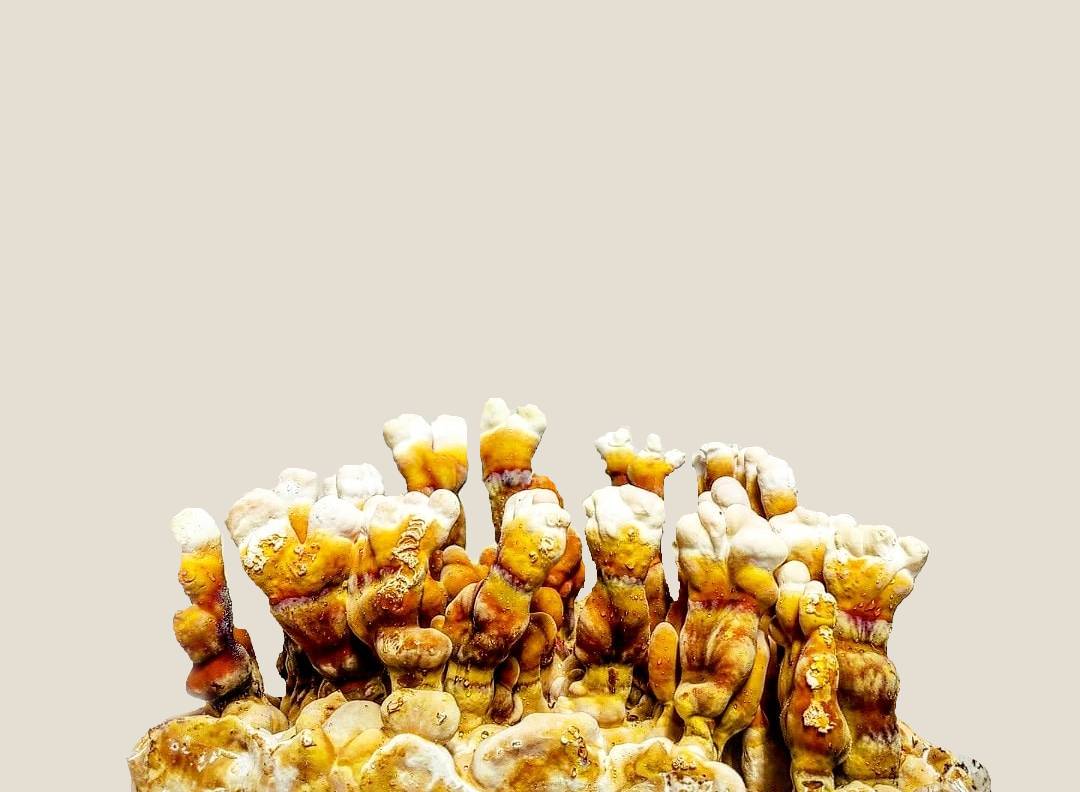
Beech Mushroom Strains
HT-1
Brown Beech belongs to a small genus known as Hypsizygus. It produces the highest yield on master’s mix, hydrated to 60-63% total moisture content.
Brown Beech is typically fully colonized at 3-4 weeks, however incubation ranges from 4-5 weeks as you should let them sit for a while after fully colonized. Brown Beech does not like disturbances once the mycelium is connecting, this may result in poor fruiting; so make sure once it is in incubation it stays there until pins form in bag before bringing to fruit room. This strain produces best when cold shocked, either overnight or up to a week in 34 F-40 F. This stresses the mycelium into production of fruit.
Brown Beech prefers a temperature of 60 F, relative humidity 85-92% with a dry fogging system to keep water droplets from setting on the mushroom pins or heads. Brown Beech is highly susceptible to rose comb so take care to not let water settle on the caps. A standard x-cut or slit in the bag, across the top just above the filter patch, is the recommended pinset initiation technique; alternatively, slit the sides down to the substrate to release more Co2.
Brown Beech has a a lightly sweet, savory and nutty flavor, and subtly crunchy texture. A typical yield for this strain is about 2 pounds.
HT-4780
White Beech HT-4786
Cauliflower Strains
SA-ET
SA-ET is a special order status strain. It is a wild clone from Texas and is purely experimental and can only be ordered as a culture at the moment.
SC-9641
SC-9641 is a special order status strain. It is a Mycelia clone from Europe and is purely experimental and can only be ordered as a culture at the moment.
Chicken of the Woods Strains
LS-FF
LS-FF is a special order status strain. It is a wild clone from Denmark and is purely experimental and can only be ordered as a culture at the moment.
Cordyceps Strains
CM-666
CM-777
Nameko Strains
PN-CNS
PN-CNS is a special order status strain. We have not done much production with this strain so a lot of variables are still unknown, here is what we do know: The Nameko has a slow growth rate, it is of the family Pholiota, same as the Chestnut, and therefor grows in a similar fashion.
This strain prefers cool temps and high humidity for pinning. We do not have any average yield data as we have not brought this strain into our regular rotation.
Nameko has a very viscous outer layer which makes it a great mushroom for thickening sauces and soups with that umami flavor.
If you would like to try this strain be sure to write *Special Order* at the bottom of your Spawn Form.
Purple Mukitake Strains
PS-MU
PS-MU is a special order status strain. It is purely experimental and is only available as a culture for the moment.
Turkey Tail Strains
TV-442
White Oyster Strains
PO-SNOW
PO-SNOW produces stark-white, beautiful clusters with average quality in a gourmet context. It is known for a tendency toward small cap size.
White Oysters, like most Pleurotus varieties, can thrive on a wide variety of substrate recipes. It is highest-yielding on master's mix, hydrated to 60-63% total moisture content. Calcium carbonate supplementation can help to slightly increase yield and fruit quality. It is best to have a tight contact between the block and the cultivation bag, which helps to prevent premature pinning inside the bag.
Incubation ranges from 8-14 days, depending on factors such as ambient incubation temp, spawn rate and substrate recipe.
Prefers cool fruiting temps between 50-60° F, though can be fruited in colder and warmer temps with mixed results. A standard x-cut or slit through the bag and into the substrate (no more than ½”) is the recommended initiation technique. A typical yield ranges between 2-2½ lbs over two flushes.
PO-SS
PO-SS is a special order status strain. We do not have a lot of data on this strain as we have not brought it into our regular rotation. From the few tests we have done, we know that this strain can be unpredictable and displays variability in growth patterns. This strain prefers cool fruiting temps between 50-60° F, though can be fruited in colder and warmer temps with mixed results.
PO-SS, if you can successfully fruit it, produces beautiful cream colored fruits with scalloped edges.
If you would like to try this strain be sure to write *Special Order* at the bottom of your Spawn Form.
PO-MOP
special order status
PO-ELM-A
more yellow caps